Why tennis counts the way it does, how games become sets, what happens at 6-6, and how to read a tennis scoreboard without help.
Tennis scoring runs on four levels at once. Points build a game, counted 15, 30, 40 and then game. Games build a set, won by the first player to six games with a lead of two. Sets build a match, won by taking two sets out of three, or three out of five in Grand Slam men's singles. Nothing is timed, so the score is the only measure of how far through a match you are.
That nesting is what makes tennis scoring feel harder than it is. Each level has its own win condition and its own tie rule, and once you know those six rules the rest follows.
The short answer. Points go 0, 15, 30, 40, game. At 40-40 it is deuce and you must win two points in a row. Six games with a lead of two wins a set. At 6-6 a tiebreak decides it, first to 7 points, win by two. Two sets win a normal match, three win a Grand Slam men's singles match.
How does tennis scoring work within a game?
What are the points in a tennis game?
A game is won by the first player to win four points, with the score called in a fixed sequence rather than as a running total.
| Points won | Called | Note |
|---|---|---|
| 0 | Love | Always spoken, never called zero |
| 1 | 15 | |
| 2 | 30 | |
| 3 | 40 | |
| 4 | Game | Only if the opponent is on 30 or less |
| 3-3 | Deuce | Two clear points are now needed |
| Next point after deuce | Advantage | Win it and the game is yours, lose it and the score returns to deuce |
The server's score is always called first, which is why the same scoreline can be read two ways depending on who is serving.
Why is tennis scored 15, 30, 40?
The most commonly cited explanation is a clock face. Points were marked by moving a hand a quarter turn at a time: 15, 30, 45, game at 60. The 45 shortened in speech to 40, which left room for the advantage point to sit at 50 before the game closed at 60. It fits the sequence neatly.
It is worth saying plainly that this is an accepted account rather than a documented one. The numbers appear in French sources well before clock faces with minute hands were common, and no primary record confirms the origin. What is certain is that the values are labels, not quantities: 15 is not worth more than a point in a tiebreak, and the gap between 30 and 40 is the same single point as the gap between love and 15.
Why is zero called love in tennis?
Two explanations circulate. The first is that love comes from the French l'oeuf, an egg, for the shape of a zero, in the same way cricket calls a duck a duck. The second is the English idiom of doing something for love, meaning for nothing. Neither is settled. Either way, love means zero, and a game won without conceding a point is a love game.
What is deuce and advantage?
At 40-40 the score is called deuce, and from there a player must win two consecutive points to take the game. Win the first and you hold advantage, often called ad in when the server has it and ad out when the receiver does. Win the next and the game is yours. Lose it and the score goes back to deuce, which is why a single game can run for many minutes with no upper limit.
The word deuce is generally traced to the French for the fact that two points are still needed. Consistent with that, there is no advantage state in the modern shortened alternative.
What is no-ad scoring?
No-ad scoring removes the advantage entirely. At 40-40 a single deciding point is played and the winner takes the game. The receiver chooses which side to receive from, and in doubles the receiving team chooses. It is standard in tour-level doubles and in US college tennis, and common in junior and club formats, because it caps how long a match can run. If you are watching a scoreboard that never shows AD, this is why.
Games, sets and how a set is won
How many games do you need to win a set?
Six, with a lead of at least two. A set can therefore end 6-0, 6-1, 6-2, 6-3 or 6-4. At 5-5 the set continues, and 7-5 is the next available result. If it reaches 6-6, a tiebreak decides the set and it is recorded as 7-6.
How does a tiebreak work?
A tiebreak is a single game played to a different set of rules, and it is where tennis stops using 15, 30 and 40 and counts in plain numbers instead.
- First to 7 points, win by two. At 6-6 in the tiebreak, play continues to 8-6, 9-7 and beyond. There is no cap.
- Serving alternates in pairs. The player whose turn it is serves the first point only, then serve changes and each player serves two points at a time.
- Ends change every six points. So the players swap at 4-2, at 6-4, and so on.
- The set is recorded as 7-6. The tiebreak score is usually printed small beside it, so 7-6(5) means the tiebreak finished 7-5.
What is a match tiebreak?
A match tiebreak, sometimes called a super tiebreak, is played to 10 points instead of 7, win by two, and it replaces a deciding set altogether. It is standard in tour-level doubles and widespread in ITF and junior events. Since 2022 all four Grand Slams have used a 10-point tiebreak to settle a final set at 6-6, which ended the era of advantage final sets running indefinitely. The most famous of those was John Isner beating Nicolas Mahut 70-68 in the fifth set at Wimbledon in 2010.
Best of three or best of five?
Almost all professional tennis is best of three sets, so two sets win the match. Men's singles at the four Grand Slams is best of five, so three sets are needed and a match can finish 3-2 in sets after more than four hours. Everything else, including women's singles at the Grand Slams and all tour-level doubles, is best of three.
Serving, holding and breaking
Serve is the structure the whole score hangs on, and several scoring terms only make sense in relation to it.
- Two serves per point. A missed first serve is a fault. Missing both is a double fault and the point goes to the receiver.
- Let. A serve that clips the net and lands in is replayed, with no penalty.
- Serve alternates every game. Not every point. Within a game, the server serves from the right, or deuce, court on even point totals and the left, or advantage, court on odd ones.
- Hold. Winning your own service game. The expected outcome.
- Break. Winning a game the opponent served. Because holding is expected, a single break usually decides a set.
- Break point. The receiver is one point from winning the game. Three break points at once is often written 0-40.
- On serve. Neither player has broken, so the set score reflects the serving order rather than a lead.
- Change of ends. Players swap after the first game and every second game after that, and at the end of a set unless the set had an even number of games.
There is one clock in professional tennis and it is not a match clock. The shot clock, commonly 25 seconds, limits the gap between points. It says nothing about who is winning.
How is doubles scored?
Doubles uses the same point, game and set structure, with three differences worth knowing. Tour-level doubles is played with no-ad scoring, so there is no advantage. A match tiebreak to 10 replaces the deciding third set. And serving order is fixed for the set: each pair nominates who serves first, and the receiving pair nominates who receives in the deuce court, so both patterns repeat until the set ends.
How do you read a tennis scoreboard?
A tennis scoreboard reads left to right in order of how permanent the information is.
| What you see | What it means |
|---|---|
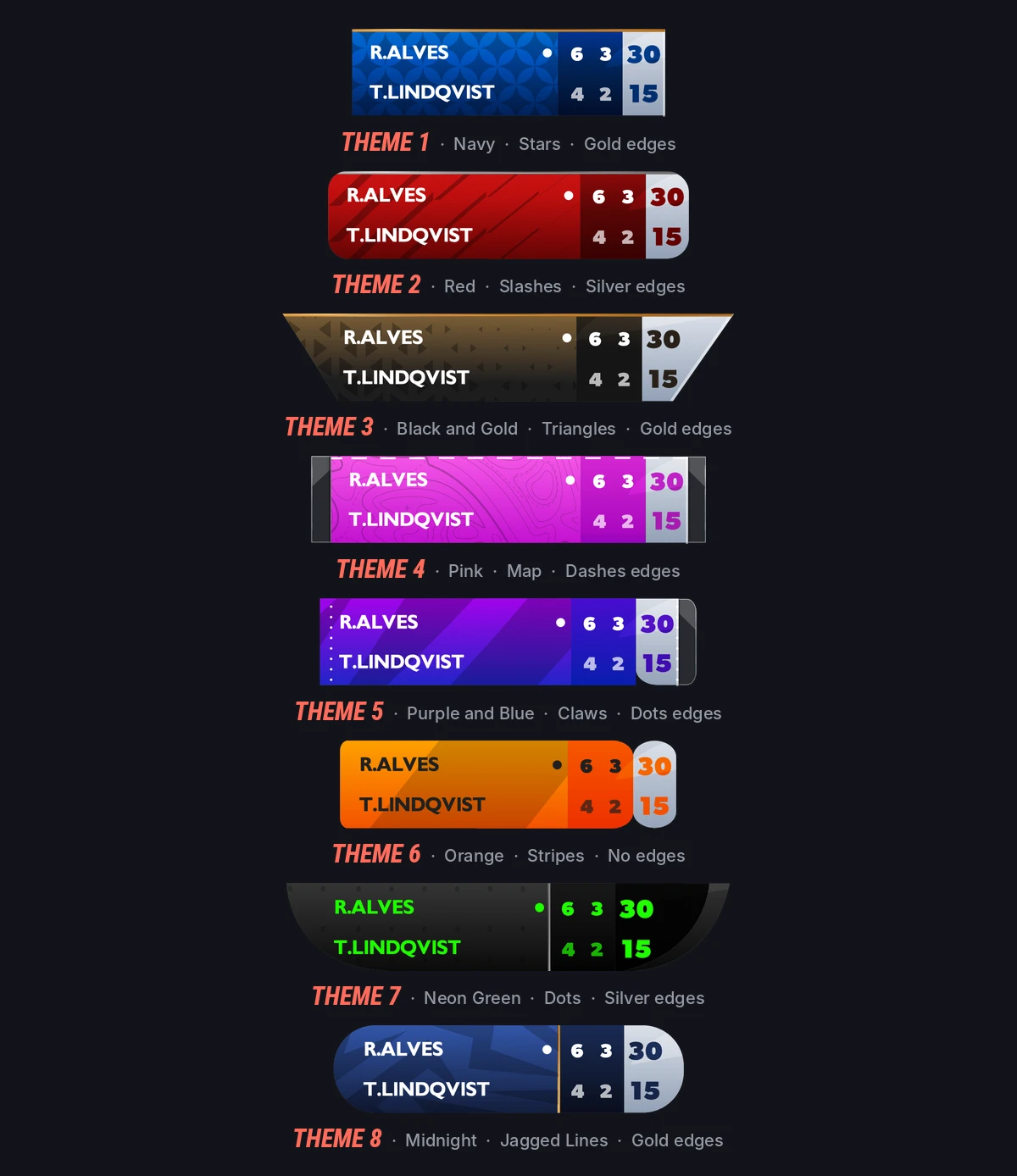
| Two names stacked | The server is marked with a dot, arrow or highlight. Without it the score is ambiguous |
| Completed set columns | Games won in each finished set, oldest on the left, for example 6-4 3-6 |
| A small raised number | The tiebreak score in a set that finished 7-6, so 7-6(4) means the tiebreak went 7-4 |
| Current set column | Games won so far in the set being played |
| Right-hand column | The point score in the current game: 0, 15, 30, 40 or AD, or a plain count in a tiebreak |
| A highlighted point score | Break point, set point or match point, worked out from the score rather than sent as an event |
The single most useful habit is reading the set columns before the point score. A player at 40-0 may still be two sets down. We have written a separate guide to what a tennis scoreboard graphic has to carry, including why the serve indicator is harder to get right than it looks.
Tennis scoring terms
| Term | Meaning |
|---|---|
| Love game | A game won without conceding a point |
| Ad in / ad out | Advantage to the server / advantage to the receiver |
| Set point | One point from winning the set |
| Match point | One point from winning the match. Called championship point in a final |
| Bagel | A set won 6-0 |
| Breadstick | A set won 6-1 |
| Golden set | A set won without losing a single point. Extremely rare |
| Retirement | A player unable to continue after the match has started. The score stands as played |
| Walkover | A player withdraws before play begins. No score is recorded |
| Default | A player disqualified, usually the last step of the code violation ladder |
Code violations follow an escalating scale: a warning first, then a point penalty, then a game penalty, then default. The game penalty is the one that surprises people, because it changes the game score with no point played.
What has changed in tennis scoring recently?
Three changes have reshaped how a match ends.
- Final-set tiebreaks are now universal at the Grand Slams. Since 2022 all four use a 10-point tiebreak at 6-6 in the deciding set. Before that each ran its own rule, and marathon final sets were possible at three of the four.
- Electronic line calling has largely replaced challenges. Where live line calling is in use, calls are automatic and there are no challenges to count. Wimbledon replaced its line judges with electronic calling in 2025, and the ATP Tour moved to it across its events the same year.
- The shot clock is enforced. A visible 25-second countdown between points is now standard at tour level, which is the closest tennis has come to a clock without becoming a timed sport.
Scoring tennis for a live stream
Tennis is unusually demanding to score for an audience, because the graphic has to hold points, games, sets and serve at once and switch its own point display when a tiebreak starts. LIGR runs tennis at scale on the WTA Tour and across the ITF World Tennis Tour, with a scorebug, a full set-by-set scoreboard and a match summary driven from the same match data.
Where an official feed exists LIGR takes it. Across most of the professional calendar there is no feed at all, so an operator scores the match in LIGR's LiveScore app and the output is identical either way. Because the score is data-bound in FUSE, a best-of-five singles match and a no-ad doubles match run the same published graphics with different settings. More on LIGR for tennis.
Every function, live
The extensions above are the states this scorebug carries. Each fires from a single data change.
Frequently asked questions
How does tennis scoring work?
Points within a game are counted 0, 15, 30, 40, then game, and at 40-40 the score is deuce and a player must win two points in a row. Six games with a lead of two wins a set, and at 6-6 a tiebreak to 7 points decides it. Two sets win most matches, and three sets win a Grand Slam men's singles match.
Why is tennis scored 15, 30, 40?
The most commonly cited explanation is a clock face, with points marked by quarter turns at 15, 30 and 45, the 45 shortened in speech to 40 so that advantage could sit at 50 and the game close at 60. It is an accepted account rather than a documented one. The numbers are labels for the first, second and third points, not quantities.
Why is zero called love in tennis?
Two explanations are commonly given and neither is settled. One traces love to the French l'oeuf, an egg, for the shape of a zero. The other is the English idiom of playing for love, meaning for nothing. Either way, love means zero, and a game won without conceding a point is called a love game.
What does deuce mean in tennis?
Deuce is the score at 40-40, from which a player must win two consecutive points to take the game. Winning the first gives that player advantage, and winning the next wins the game. Losing it returns the score to deuce, so a single game has no upper limit. In no-ad scoring, deuce is replaced by one deciding point.
How many games do you need to win a set in tennis?
Six, with a lead of at least two, so a set can end 6-0 through to 6-4. At 5-5 play continues and the next available result is 7-5. If the score reaches 6-6, a tiebreak decides the set and it is recorded as 7-6, with the tiebreak score often shown in brackets beside it.
How does a tennis tiebreak work?
A tiebreak is played to 7 points, win by two, and points are counted in plain numbers rather than 15, 30 and 40. The player due to serve serves the first point only, after which serve alternates every two points, and the players change ends every six points. The set is then recorded as 7-6.
What is a match tiebreak in tennis?
A match tiebreak is played to 10 points, win by two, and replaces a deciding set entirely. It is standard in tour-level doubles and widespread in ITF and junior tennis. Since 2022 all four Grand Slams also use a 10-point tiebreak to settle a final set that reaches 6-6, which ended the possibility of marathon deciding sets.
Is a tennis match best of three sets or best of five?
Almost all professional tennis is best of three sets, so two sets win the match. The exception is men's singles at the four Grand Slams, which is best of five and needs three sets to win. Women's singles at the Grand Slams and all tour-level doubles are best of three.
Putting tennis on screen
Scorebug, full scoreboard and match summary, driven by an official feed or by an operator with a phone. The same graphics either way, on any court.