Basketball has a three tier point system. A free throw is worth one point, a field goal from inside the arc is worth two, and a shot from behind the three point line is worth three. Everything else, the and-one, the four point play, the bonus, is a consequence of those three values and how fouls are punished.
The value of a shot depends on where the shooter's feet were, not on how the ball went in. This page answers the scoring questions in order: what each action is worth, how free throws are awarded, where the three point line sits in each competition, how a game ends, and what the abbreviations on a box score mean. For the graphics side, see the master scoreboard guide.
The basketball point system at a glance
| Scoring action | Points | When it applies |
|---|---|---|
| Free throw | 1 | An unopposed shot from the free throw line, awarded after certain fouls |
| Field goal inside the arc | 2 | Any made shot where the shooter was inside the three point line |
| Field goal behind the arc | 3 | Any made shot where both feet were behind the three point line at take off |
| And-one | 2 or 3, plus 1 | A basket made while being fouled, followed by one free throw |
| Four point play | 4 | A three pointer made while being fouled, followed by one free throw |
| Own basket | 2 to the other team | Credited to an opponent, never to the player who scored it |
How many points is a free throw?
One point. A free throw is an unopposed shot from the free throw line, 4.6 metres from the backboard, taken with play stopped. It is the only shot in basketball worth a single point.
When is a shot worth two points?
Whenever the shooter released it from inside the three point arc. That includes a lay-up, a dunk, a hook, a mid range jump shot and a tip-in. The method does not matter to the scoreboard. A dunk is worth exactly the same two points as a shot from fifteen feet.
When is a shot worth three points?
When both of the shooter's feet were behind the three point line at the moment they left the floor. The ball's flight is irrelevant, and so is where the shooter lands. A player can take off from behind the line, drift forwards and land inside it, and it is still three points. Step on the line and it is two.
The single most common misunderstanding in basketball scoring: the value is set by the shooter's feet at release, not by where the ball was when it went through the ring.
What is an and-one in basketball?
An and-one is a made basket plus a foul on the shot. The basket counts, and the shooter gets one extra free throw to complete the three point or four point play. It is scored as a single sequence: two points on the field goal and one more if the free throw drops. A three pointer made while fouled becomes a four point play if the free throw goes in.
Where the 3-point line actually is
There is no universal three point distance. It changes by competition, and it is shorter in the corners of the court than at the top of the arc in the leagues that use a rounded line with straight sections.
| Competition | Top of the arc | Corners |
|---|---|---|
| NBA | 7.24 m, 23 ft 9 in | 6.71 m, 22 ft |
| FIBA, including Olympic and international basketball | 6.75 m, 22 ft 1.75 in | 6.60 m, 21 ft 8 in |
| NCAA men and women | 6.75 m, 22 ft 1.75 in | 6.75 m at the closest point |
| WNBA | 6.75 m, 22 ft 1.75 in | 6.60 m, 21 ft 8 in |
| High school under NFHS rules | 6.02 m, 19 ft 9 in | 6.02 m |
This is why a shot chart from one league does not map onto another, and why a school court often has two arcs painted on it. The value of the shot never changes: three points everywhere. Only the distance does.
How free throws are awarded
Free throws are the part of basketball scoring that trips people up, because the number awarded depends on what the fouled player was doing and on how many fouls the defending team has already committed.
| Situation | Free throws |
|---|---|
| Fouled while shooting a two point attempt, shot missed | 2 |
| Fouled while shooting a three point attempt, shot missed | 3 |
| Fouled while shooting, shot made | 1, plus the basket counts |
| Fouled away from the ball, defending team not in the bonus | 0, the fouled team gets the ball back |
| Fouled away from the ball, defending team in the bonus | 2 |
| Technical foul | 1 in the NBA, 1 plus possession under FIBA rules, 2 in college. Check the competition |
What does bonus mean in basketball?
The bonus, also called the penalty, is a state a team enters after committing a set number of fouls in a period. Once the defending team is in the bonus, every subsequent foul sends the opposition to the free throw line, even fouls that would normally just return possession. Under FIBA and NBA rules the threshold is the fifth team foul in a quarter, and the count resets at the start of each quarter. College and high school rules differ, so the number on the scoreboard is competition specific.
What is a one-and-one?
A one-and-one is a conditional pair of free throws used in some rule sets: the shooter takes one, and only earns a second if the first goes in. Miss the first and the ball is live. Several competitions have replaced it with a straightforward two shot bonus, so it now turns up more often in older footage and amateur rule books than at the top level.
How a basketball game is timed and how it ends
| Competition | Game length | Shot clock |
|---|---|---|
| NBA | Four quarters of 12 minutes | 24 seconds |
| FIBA and WNBA | Four quarters of 10 minutes | 24 seconds |
| NCAA men | Two halves of 20 minutes | 30 seconds |
| NCAA women | Four quarters of 10 minutes | 30 seconds |
| High school under NFHS rules | Four quarters of 8 minutes | Varies by state, not universal |
The clock stops on every whistle, so a forty minute game runs well past two hours in real time. Two clocks run at once: the game clock, and the shot clock, which limits how long a team can hold the ball before attempting a shot that hits the rim. If the attacking team rebounds its own miss, the shot clock does not go back to the full number, it resets to 14 seconds under NBA and FIBA rules.
Basketball games cannot end in a draw. Level scores at the end of regulation means a five minute overtime period, repeated as many times as necessary until one team is ahead when a period ends. A shot released before the buzzer counts if it goes in, which is why a game can be decided after the clock reads 0:00.
How to read a basketball box score
| Abbreviation | Meaning |
|---|---|
| PTS | Points scored |
| FG, FGA, FG% | Field goals made, attempted and the percentage. Includes both twos and threes |
| 3P, 3PA, 3P% | Three pointers made, attempted and the percentage |
| FT, FTA, FT% | Free throws made, attempted and the percentage |
| REB, OREB, DREB | Total rebounds, split into offensive and defensive |
| AST | Assists, a pass that leads directly to a made basket |
| STL, BLK | Steals and blocked shots |
| TO | Turnovers, possessions given away |
| PF | Personal fouls. Five is a foul out under FIBA and college rules, six in the NBA |
| +/- | The team's net score while that player was on court |
| MIN | Minutes played |
Two derived terms come up constantly. A double-double is double figures in two of points, rebounds, assists, steals or blocks. A triple-double is double figures in three of them, and is usually points, rebounds and assists.
How to read a basketball scoreboard during a game
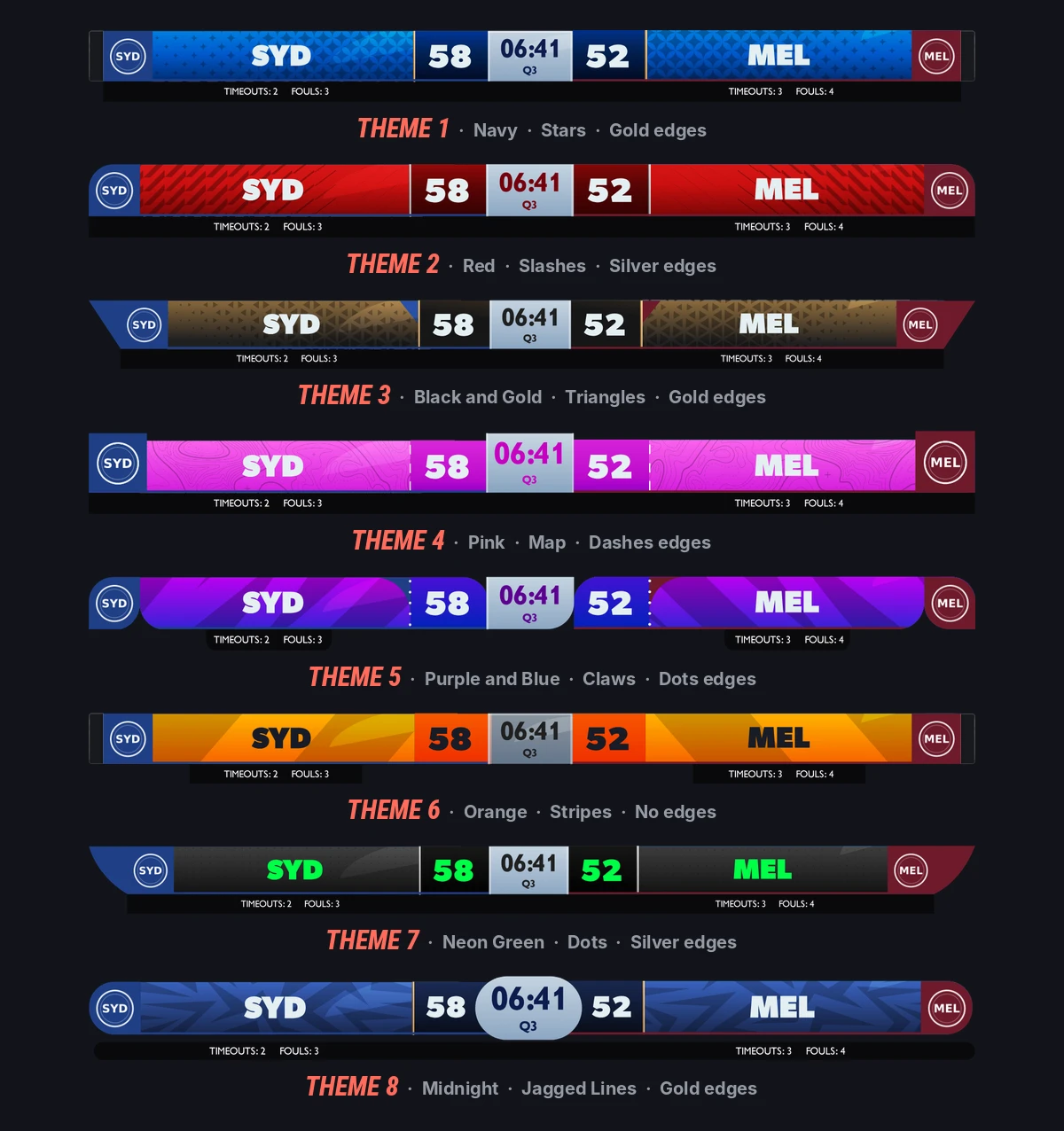
The on screen graphic carries the score, the period, the game clock, the shot clock, each team's foul count with bonus state, and timeouts remaining. The two clocks are the giveaway that you are looking at a basketball graphic rather than any other sport. The team foul number matters more than it looks: once it reaches the bonus threshold, the next foul is two free throws rather than a throw-in, which changes how both teams defend. Our guide to what a basketball scoreboard must show breaks down every element and where the data for it comes from.
Where this fits at LIGR
LIGR produces the live graphics that carry this on a broadcast or a stream. Scoring events are typed, so the overlay adds the value carried by the event rather than a generic plus one, and the bonus is modelled as a state rather than a counter. Where a competition has an official data feed, LIGR takes it. Where it does not, which is most basketball below the top tier, the LiveScore app is the feed and an operator taps the real events. Graphics are bound to that data in FUSE and run in a browser with no hardware courtside. LIGR works in basketball with Basketball NSW, the Horizon League and the EuroMillions Basketball League in Belgium. More on basketball at LIGR.
Every function, live
The extensions above are the states this scorebug carries. Each fires from a single data change.
Frequently asked questions
How does basketball scoring work?
Basketball uses three point values. A free throw is worth one point, a field goal taken from inside the three point arc is worth two, and a field goal taken from behind the arc is worth three. The team with more points when the final period ends wins. There are no draws, so level scores send the game to five minute overtime periods.
How many points is a free throw worth?
One point. Free throws are unopposed shots taken from the free throw line with the clock stopped, awarded after a shooting foul, after a technical foul, or after any foul once the defending team has reached its team foul limit for the period. They are the only one point score in basketball.
What is the basketball point system?
One point for a free throw, two for a made shot from inside the three point line and three for a made shot from behind it. The value depends on where the shooter's feet were when they left the floor, not on how far the ball travelled. A basket made while being fouled adds a free throw on top, which is where three and four point plays come from.
What is an and-one in basketball?
An and-one is when a player is fouled while shooting and the shot still goes in. The basket counts and the shooter gets one free throw, so a two point basket becomes a possible three point play and a three pointer becomes a possible four point play. The extra free throw is awarded whether or not the defending team is in the bonus.
How far is the 3-point line?
It depends on the competition. The NBA line is 7.24 m, or 23 ft 9 in, at the top of the arc and 6.71 m, 22 ft, in the corners. FIBA, the WNBA and college basketball use 6.75 m, 22 ft 1.75 in. High school courts under NFHS rules use 6.02 m, 19 ft 9 in. The shot is worth three points at every one of those distances.
What does bonus mean on a basketball scoreboard?
It means the defending team has committed enough fouls in the period that every further foul sends the opposition to the free throw line. Under FIBA and NBA rules the threshold is the fifth team foul in a quarter, and the count resets when the quarter ends. It is a persistent state rather than a one-off event, which is why it sits on the scoreboard all period.
How many fouls before a player fouls out?
Five personal fouls under FIBA and NCAA rules, six in the NBA. A player who reaches the limit takes no further part in the game and must be substituted. Technical and flagrant fouls are recorded separately, and a flagrant 2 or a second technical results in immediate ejection regardless of how many personal fouls the player has.
Can a basketball game end in a tie?
No. If the scores are level at the end of the fourth quarter or second half, the teams play a five minute overtime period, and keep playing overtime periods until one side leads at the end of one. A shot released before the buzzer counts if it goes in, so a game can be won after the clock has already reached zero.
Put basketball scoring on screen properly
Two clocks, typed scoring events, team fouls with a real bonus state and timeout pips. Cloud rendered broadcast graphics, no hardware, no per match operator required.