Rally scoring, the 25-point set, the two-point margin, the deciding set to 15, and every rule you need to read a volleyball scoreboard.
In volleyball, every rally is worth exactly one point. The team that wins the rally wins the point, whether it served or not, and a set is won by the first team to reach 25 points with a lead of at least two. There is no game clock. A kill, a block, an ace and an opponent's error are all worth the same single point, which makes volleyball one of the simplest sports to score and one of the easiest to misread if you do not know where the set score sits.
The short answer. One point per rally, to whichever team wins it. Sets are played to 25, win by two, with no upper limit. The deciding set is played to 15, win by two. Indoor matches are best of five sets. Beach matches are best of three, played to 21, with a deciding set to 15.
How does volleyball scoring work?
How do you win a point in volleyball?
A rally begins with a serve and ends the moment the ball hits the floor, goes out of play, or a team commits a fault. Whichever team did not make the mistake gets the point. No rally can end without a point being awarded.
There are four ways to win one:
- Kill. An attack that lands in the opponent's court or forces an unplayable touch. The most common point in the sport.
- Block. A ball stopped at the net that drops on the attacking side. A block does not count as one of the blocking team's three hits.
- Ace. A serve that lands in and is not returned, or is touched but not controlled.
- Opponent error. Everything else: the ball hit out, into the net, a serve missed, a handling fault. In most matches this is a bigger share of the score than any positive action.
How many points is each scoring action worth?
One. All of them. Volleyball has no equivalent of a three-pointer or a try and conversion. A 40-shot rally finished with a cross-court kill is worth the same as an opponent serving into the net. Because errors and winners are priced identically, a team that simply keeps the ball in play wins a lot of volleyball.
What is rally scoring, and what came before it?
Rally scoring means a point is awarded on every rally regardless of who served. It is what volleyball has used at international level since 1999. Before that the sport used side-out scoring: only the serving team could score, so a receiving team that won a rally won the serve but no point, and sets ran to 15. Moving to rally scoring, with sets extended to 25 to compensate, is the largest change in the sport's modern history, and it is why old and new volleyball scores are not comparable.
One piece of the old language survives. Winning the rally when your opponent served is still called a side-out, because the serve changes sides. It now brings a point with it.
Sets, matches and how a set ends
How many points do you need to win a volleyball set?
Twenty-five, and you must lead by two. A set cannot finish 25-24. If the score reaches 24-24 the set continues until one team is two clear, so 26-24, 27-25 and 32-30 are all legal final scores. There is no cap at international level, which is why a volleyball scoreboard has to allow room for three digits.
What happens at 24-24 in volleyball?
Play simply continues. Each point either puts a team at set point or levels the score again. There is no tiebreak game and no sudden death. The only tie volleyball resolves with a different format is the match itself, settled by a shorter deciding set.
How many sets do you need to win a volleyball match?
Three, in the standard indoor format of best of five, so a match finishes 3-0, 3-1 or 3-2. The total point count across sets is irrelevant: a team can score more points overall and still lose. The fifth set, played only at 2-2, is the deciding set and runs to 15 rather than 25, still win by two.
| Format | Sets in a match | Points to win a set | Deciding set |
|---|---|---|---|
| Indoor, international and most senior competitions | Best of five, first to three | 25, win by two | Fifth set to 15, win by two |
| Indoor, best of three formats | Best of three, first to two | 25, win by two | Third set to 15, win by two |
| Beach volleyball | Best of three, first to two | 21, win by two | Third set to 15, win by two |
Whichever format is in use, the deciding set is shorter. It is the one place a volleyball scoreboard changes its own arithmetic mid-match, and the thing amateur scoring apps most often get wrong.
What gives the other team a point?
Because errors score, knowing the faults is the same as knowing the scoring. These all hand a point and the serve to the opposition.
- Four hits. A team may touch the ball three times before returning it. A block does not count as a touch.
- Double contact or a lift. Touching the ball twice in succession, except on a team's first contact, or letting it come to rest rather than rebound.
- Net touch or centre line violation. Contact with the net during play, or fully crossing the line into the opponent's court.
- Ball out. Landing outside the court, or passing outside an antenna.
- Serving faults. A foot on the line, a serve into the net, or a serve out.
- Rotational fault. Players out of rotational order at the moment of the serve.
- Back-row attack fault. A back-row player attacking above net height from in front of the attack line.
Timeouts and the sport with no clock
Volleyball is not timed. No period of a match is measured in minutes, so nothing on a volleyball scoreboard counts up or down except the intervals. That is unique among the major team sports.
- Team timeouts. Two per team per set, 30 seconds each, reset at the start of every set.
- Technical timeouts. Where a competition uses them, they trigger automatically at 8 and 16 points in a non-deciding set, and never in the deciding set. They do not use up a team's own two.
- Substitutions. Six per set under international rules. Domestic codes, including US college volleyball, allow considerably more, so check your own competition's rulebook.
In the deciding set, teams change ends when one side reaches 8 points. Nothing about the score changes when they do.
Cards, and the one that changes the score
- Yellow card. A warning. Nothing on the scoreboard changes.
- Red card. A penalty. The opposition is awarded a point and the serve.
- Both cards in one hand. Expulsion for the remainder of the set.
- Both cards, one in each hand. Disqualification for the rest of the match.
The red card is the only point in volleyball not won in a rally. If the score moves while the ball is dead, that is usually why.
Beach volleyball scoring
Beach volleyball uses the same one-point-per-rally system with three differences. Sets are played to 21 rather than 25, a match is best of three, and teams switch ends every 7 points in a 21-point set, or every 5 points in the deciding set to 15, to keep sun and wind fair. Each team has one timeout per set, and with two players a side there is no rotation to track.
How to read a volleyball scoreboard
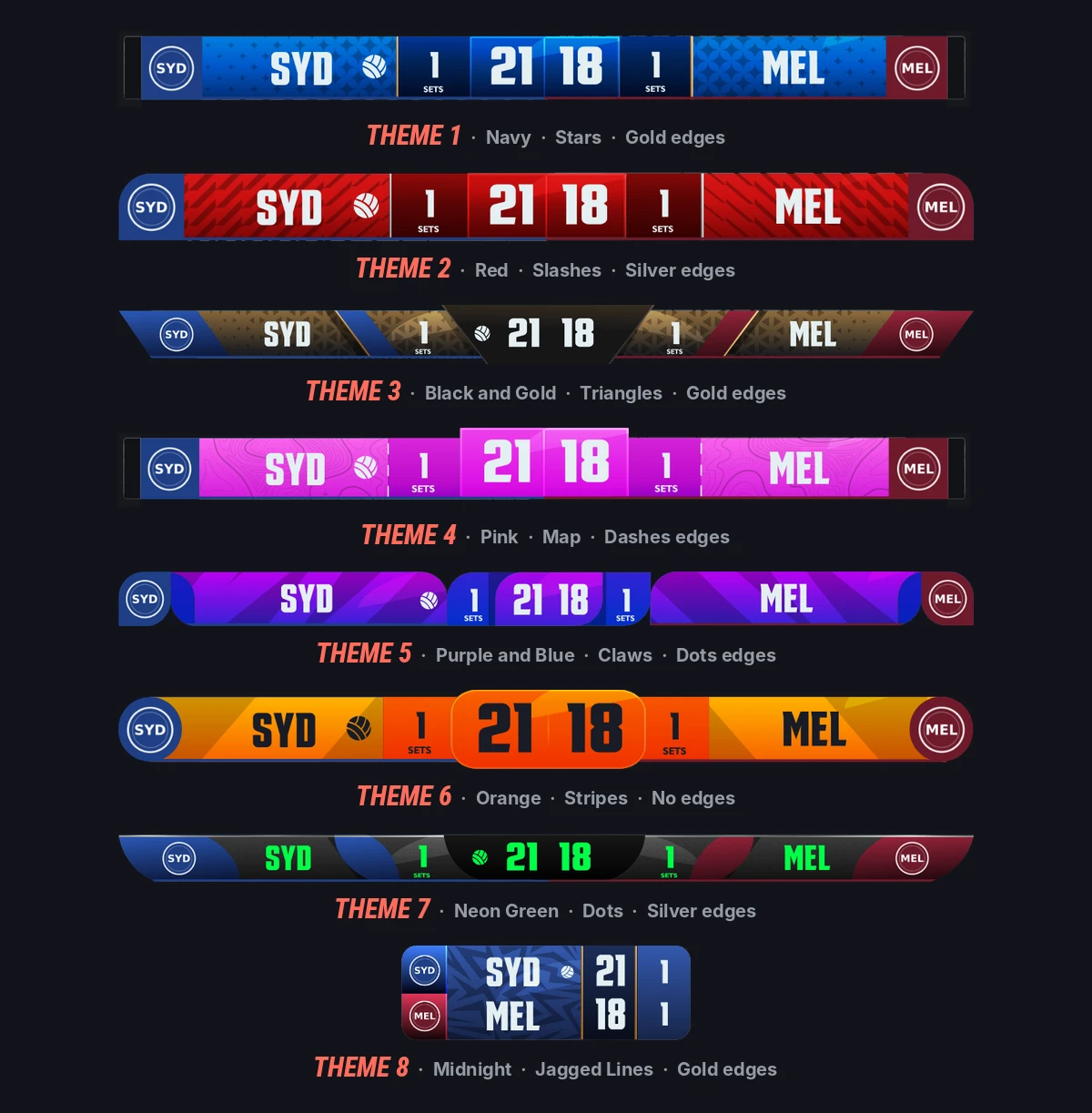
A volleyball scoreboard carries two scores at once, and confusing them is the classic beginner mistake.
- The large pair of numbers is the score in the current set. It resets to 0-0 each set.
- The small pair is the sets won, and it is the only element telling you how far through the match you are. A scoreline of 18-14 means nothing until you know whether it is set one or set five.
- The serve indicator is an arrow, dot or highlight beside one team. Serve dictates rotation, so without it the next rally is unreadable.
- Timeout pips are two dots per team, emptying as timeouts are used and refilling each set.
- Set point and match point are worked out from the score, not sent by any feed, and the calculation has to use the right target: 15 in a deciding set, 25 everywhere else.
We have broken down every element in a volleyball scoreboard graphic separately, including the serve indicator and the challenge counter.
What do the volleyball scoring abbreviations mean?
| Abbreviation | Means | Note |
|---|---|---|
| K | Kill | An attack that ends the rally in your favour |
| E | Attack error | An attack out, into the net, or blocked back down |
| TA | Total attempts | Every attack swing, successful or not |
| PCT | Hitting percentage | Kills minus errors, divided by total attempts. It can be negative |
| A | Assist | The set that led directly to a kill, usually the setter's column |
| SA / SE | Service ace / service error | A serve that wins the point, or one that loses it |
| RE | Reception error | A serve receive that hands over the point |
| D | Dig | Keeping an opponent's attack alive |
| BS / BA | Block solo / block assist | Two players on a block share the credit |
Hitting percentage is the number to understand first: kills minus attack errors, divided by total attempts. A player with 10 kills and 10 errors from 30 swings sits at zero, and anyone making more errors than kills posts a negative figure.
What has changed in the volleyball rules recently?
The arithmetic has been stable since rally scoring arrived. The changes since have been about review and administration.
The video challenge system is the main one, and it is routinely reported the wrong way round. A team keeps the right to challenge for as long as its claims are correct, and the limit is two unsuccessful challenges per set. The number shown on screen is how many failed challenges a team can still afford, not how many challenges it has left. A successful challenge costs nothing.
The second is that technical timeouts, once automatic at 8 and 16 everywhere, are now optional and many competitions have dropped them. Treat them as a competition setting rather than a rule of the sport.
Scoring a volleyball match for a live stream
Scoring for an audience is two jobs at once: keeping the official record, and driving what viewers see. LIGR's LiveScore app is built for the second. An operator presses the real events, point, ace, block, timeout, card, and the graphic follows, with every event timestamped so the same input also produces statistics and highlight clips. Where an official data feed exists LIGR takes that instead, and the graphics are identical. Below the top tier of most sports there is no feed at all, which is why the scoring app matters. The overlay is data-bound in FUSE, so the set score, serve side and deciding-set target are variables rather than a redraw. More on LIGR for volleyball and the full feature set.
Every function, live
The extensions above are the states this scorebug carries. Each fires from a single data change.
Frequently asked questions
How does volleyball scoring work?
Volleyball uses rally scoring: one point is awarded on every rally to whichever team wins it, regardless of which team served. Sets are played to 25 points and must be won by two, with no upper limit, so scores such as 27-25 are normal. A match is usually best of five sets, and the deciding fifth set is played to 15 rather than 25.
How many points do you need to win a volleyball set?
Twenty-five, with a lead of at least two. If the score reaches 24-24 the set continues until one team is two points clear, so 26-24 or 30-28 are legal results. The exception is the deciding set, the fifth in a best-of-five match or the third in a best-of-three, which is played to 15 points, also win by two.
How many points is a kill, a block or an ace worth in volleyball?
One point each. Volleyball has no multi-point scoring actions. A kill, a stuff block, a service ace and an unforced error by the opposition are all worth exactly the same single point. The only difference between them is how they are recorded in the statistics, not what they do to the score.
How many sets are in a volleyball match?
Indoor volleyball is normally best of five sets, so a team needs three sets to win and the match can finish 3-0, 3-1 or 3-2. Beach volleyball and many junior and school competitions are best of three, so two sets win it. Total points across the match do not matter: a team can score more points overall and still lose.
What is a side-out in volleyball?
A side-out is winning the rally when the other team served, which gives you the serve. Under the old side-out scoring system, used before 1999, that was all it gave you, because only the serving team could score. Under modern rally scoring a side-out wins the point as well as the serve, and the winning team rotates one position clockwise.
Is beach volleyball scored differently from indoor volleyball?
The point system is identical, one point per rally, but the format is not. Beach sets are played to 21 rather than 25, a match is best of three rather than best of five, and the deciding third set is played to 15. Teams also switch ends every 7 points in a 21-point set and every 5 points in the deciding set.
Does a red card change the score in volleyball?
Yes. A red card in volleyball is a penalty, not just a warning, and it awards the opposition a point and the serve. A yellow card is a warning and changes nothing. Both cards shown together in one hand is an expulsion for the remainder of the set, and shown separately in each hand is disqualification for the rest of the match.
Putting volleyball on screen
LIGR is a cloud-native broadcast graphics platform for live sport. Score a match in the app, or take a data feed, and the scoreboard, stat panels and highlights follow automatically.