Every element a volleyball scoreboard overlay has to carry, why the absence of a game clock changes the entire design, and how the graphic gets driven live.
A volleyball scoreboard has to carry six things continuously: both team names or crests, the points in the current set, the number of sets each team has won, the set number, which team is serving, and the timeouts each team has left. In a live broadcast the same graphic is also called the scorebug. There is no game clock, because volleyball does not use one. The set score is the only element telling a viewer how far through the match they are.
That absence is not a simplification. It is why a volleyball bug cannot be a re-skinned football or basketball overlay. In every clock sport the bug has one permanently moving element anchoring the viewer to the state of the game. Volleyball has nothing of the kind, and every design decision below follows from that.
What a volleyball scoreboard must show
| Element | Why it matters | Source of data |
|---|---|---|
| Current-set points | The live state of the set. Changes on every rally, far more often than a score changes in most sports. | Point event, feed or scoring app |
| Sets won | The only indicator of match progress. A viewer joining at 18-14 has no way of knowing whether that is set one or set five. | Derived from set-won events |
| Set number | Tells viewer and graphic alike whether this set runs to 25 or, as a deciding set, to 15. | Match state |
| Serve indicator | Serve drives rotation and dictates which side is receiving. Without it the next rally is unreadable. | Change-of-server event |
| Timeouts remaining | Two per team per set. Late in a tight set, whether a coach still holds one is a tactical fact. | Timeout event, reset each set |
| Challenge count | Shows how much video review a team can still afford to get wrong. | Challenge outcome events |
| Team identity | Crest, abbreviation and colour. Fixed, but the anchor for everything else. | Fixture data |
| Set point / match point | Not sent by anything. A derived state the graphic has to compute and clear itself. | Computed from the score |
The clock is the hard part, because volleyball does not have one
Volleyball uses rally scoring: every rally ends in a point for one side, whether or not that side served. Sets are played to 25 and must be won by two. The deciding set is played to 15, also by two. Matches are best of five or best of three depending on the competition. Nothing in that structure references time, and three consequences fall out of it.
The bug has no moving part. Between rallies a volleyball scoreboard is completely static, sometimes for twenty or thirty seconds at a stretch. That sounds easier. It is harder, because every imperfection sits motionless in front of the viewer. Numerals must be tabular, so a 9 becoming a 10 does not shove the team name sideways, and point slots have to be reserved at full width from the first serve. A set that reaches deuce has no upper limit, so the layout cannot assume two digits will do.
Set point and match point are computed, not delivered. No feed publishes a set point event. The graphic derives the state from the score, and it has to respect both the two-point margin and the fact that a deciding set targets 15 rather than 25. If the condition is written as "leader has 24", the overlay will sit on SET POINT through a 24-24 deuce and be wrong in the most visible moment of the set.
The only clocks are the timeouts. Each team has two per set, and the allowance resets every set rather than carrying over. Competitions that use technical timeouts trigger them automatically at 8 and 16 points in sets one to four, never in the deciding set, and they must not decrement a team's own dots. Add the interval between sets and that is the complete inventory of countdowns in the sport.
A volleyball scoreboard is built around four counters that reset at different boundaries: points reset every set, timeouts reset every set, challenges reset every set, and sets won reset only at the end of the match. Getting the reset boundaries right is most of the engineering.
Scoring events and what the scoreboard does
- Point. One team's score increments and, where known, a chip names the reason: kill, block, opponent error or ace. If the reason is missing the chip should disappear, not print a placeholder.
- Ace. A point won directly from the serve. The graphic names the server and should only fire when the serving team actually won the rally, which guards against mislabelled data.
- Service error. A point to the opposition off a serving fault: net, foot fault or out. Worth distinguishing from a general point because it is attributed to a named player.
- Change of server. The serve indicator moves to the other side. This only happens on a side-out. Consecutive serves by the same team must not retrigger it.
- Set won. The sets tally increments and the set number advances. The tally must be correct before the set-won card leaves screen, or the two contradict each other for a beat.
- Match won. Fires only once the final set has fully resolved, with the sets scoreline and, usually, a set-by-set summary.
Cards, sanctions and the one that changes the score
Volleyball's disciplinary ladder is unusual because one rung of it alters the scoreline directly.
- Warning. Shown as a yellow card. Nothing else changes.
- Penalty. Shown as a red card. The opposition is awarded a point and the serve.
- Expulsion. Both cards shown together in one hand. The player or coach takes no further part in that set.
- Disqualification. Both cards shown separately, one in each hand. The offender leaves for the remainder of the match.
The design consequence is direct. On a red card the score changes. If disciplinary and scoring events travel down separate paths in the graphics stack, the viewer sees a red card and, in the same moment, an unexplained point. In volleyball they are one event and the overlay must treat them as one. Expulsions and disqualifications also have to feed back into the lineup graphic, so a player out for the set is not still shown on court.
Extensions: the stats worth putting on the bug
A scorebug extension is a stat panel that pops out of the bug rather than replacing it. Volleyball has natural windows for them: technical timeouts, team timeouts and a three-minute interval between sets.
- Challenge counter. The one nearly everybody labels wrongly. Under the FIVB video challenge system a team keeps the right to challenge for as long as its claims are correct, and the limit is two unsuccessful challenges per set. So the number on screen is how many failures a team can still afford, not how many challenges it has left. A successful challenge costs a team nothing.
- Rotation panel. Six positions in a two-by-three grid, with the server at position one and the libero flagged. The libero plays back row only, so a rotation graphic that renders a libero in a front-row position is displaying an impossible state.
- Point-reason splits. Kills, blocks, aces and opponent errors. These should reconcile: the four categories added together are the set score.
- Set-by-set line and end-of-set summary. The closest thing volleyball has to a match narrative, and how a late-joining viewer catches up in one graphic.
- Sponsor rail. Extension panels can carry a sponsor lockup, and a set break is better inventory than anything a continuous-clock sport offers.
How LIGR drives a volleyball scoreboard online
The data question comes first. Where an official feed exists, LIGR takes it. Where one does not, and below the top tier there usually is not one, the LiveScore app is the feed: an operator presses the real match events as they happen, point, ace, block, timeout, substitution, card, and each is written with a timestamp. The graphics do not know which source fed them. That is what makes volleyball viable at competition level, not only international level.
The overlay itself is data-bound in FUSE, so volleyball's set score, serve side, timeout dots and challenge count are variables rather than a redraw. A set boundary changes the values in those variables; it does not require a different graphic. The animation work is done in Rive and published through FUSE, and the whole thing renders in HTML5, which is why the cost per match is close to nothing.
Game Plans handles what fires automatically: the set-won card, the technical timeout panel at 8 and 16, the extension panel during the interval. Anything you would rather call by hand runs from the Control Room. Full auto-mode with no operator is available where the data carries it, and the same platform runs the DAZN National League at more than 650 matches a season.
Volleyball is a sport LIGR is building out now, and the requirements above are what the graphic is built against. For the wider picture, see the master scoreboard guide and the volleyball page.
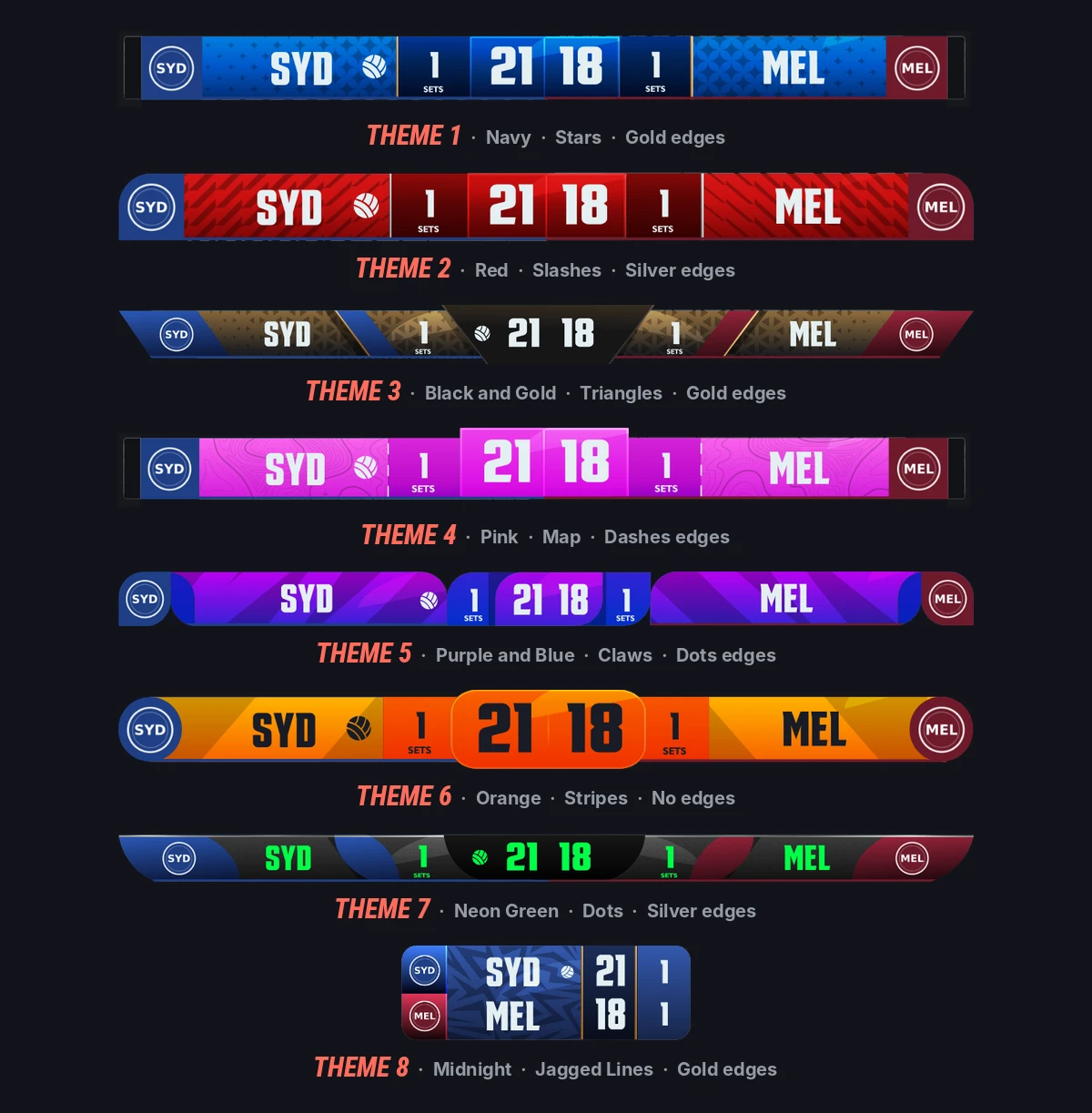
Every function, live
The extensions above are the states this scorebug carries. Each fires from a single data change.
Frequently asked questions
What is a volleyball scoreboard overlay?
A volleyball scoreboard overlay is the graphic layered over a live stream, and broadcasters call the same thing a scorebug. It must show both teams, the points in the current set, the sets each team has won, the set number, which team is serving and the timeouts left. There is no game clock to show. An online volleyball scoreboard renders in the browser and takes its numbers from a data feed or from a volleyball scoreboard app at the scorer's table.
Does a volleyball scoreboard need a clock?
No. Volleyball has no game clock. Sets are won by reaching a points target, not by time expiring, so a volleyball scorebug carries no elapsed or countdown timer. The only timers on screen are timeout countdowns and the interval between sets. That is the biggest structural difference between a volleyball overlay and a football, basketball or hockey one.
What does a volleyball scorebug show?
Six elements, permanently: both team names or crests, the points in the current set, the sets won by each team, the set number, which team is serving, and the timeouts each team has left. Most broadcast bugs add a seventh, the challenge count, and a derived eighth, the set point or match point indicator.
How does a scorebug know it is set point?
It works it out. No data feed publishes a set point event. The graphic derives it from the score: the leader must be one point from the target and satisfy the two-point margin. It also has to use the right target, because a deciding set is played to 15, not 25. Get either wrong and the overlay sits on SET POINT through a deuce.
How many video challenges does each volleyball team get per set?
Under the FIVB video challenge system a team may keep challenging for as long as its claims are correct. The limit is two unsuccessful challenges per set, after which that team cannot challenge again in that set. A successful challenge costs nothing. That means the number on the bug is a count of failures a team can still afford, not a count of challenges it can still make.
How are volleyball timeouts displayed on a scoreboard?
Each team gets two timeouts per set, usually drawn as two dots or pips under the team block, and they reset to two at the start of every set rather than carrying over. Competitions that use technical timeouts trigger them automatically at 8 and 16 points in sets one to four, and never in a deciding set. A technical timeout must not decrement a team's own allowance.
Can the same scorebug template be used for volleyball and football?
Not without rebuilding it. A football bug is organised around a running clock and one score pair. A volleyball bug has no clock, carries two scores at once (current-set points and sets won), needs a persistent serve indicator, and needs per-set counters that reset at set boundaries. Layout, data model and reset logic all differ.
Put a volleyball scoreboard on your stream
Cloud-native broadcast graphics, driven by a feed or by your own volleyball score keeper. No hardware, no operator per camera, no per-match render bill.