One goal, one point on the scoreboard. Everything else in soccer scoring is about what happens when the two teams finish level.
Soccer has exactly one scoring action. A goal is worth one, and it counts when the whole of the ball crosses the whole of the goal line between the posts and under the crossbar. A tap-in from half a metre and a 30-metre strike are worth the same. There is no bonus for distance, no conversion to follow, and no partial score, which makes soccer the simplest major sport to score and the reason most matches finish with a total under four.
The complexity sits elsewhere: in how the clock runs, in what happens when a match is tied, and in how a result converts into league points.
The short answer. A goal is worth one point and is the only way to score. A match is 90 minutes in two halves, plus announced stoppage time. In a league a win is worth three points, a tie one and a loss none. In a knockout, a tie goes to 30 minutes of extra time and then a penalty shootout.
How is soccer scored?
How do you score a goal in soccer?
By getting the ball fully over the goal line, between the posts and under the bar, without an infringement in the build-up. The requirement that the whole ball crosses the whole line is why goal-line technology exists: a ball resting 95 per cent over the line is not a goal.
Any part of the body except the hands and arms can score. It does not matter whether the goal comes from open play, a penalty kick, a direct free kick, a corner or a header.
How many points is a goal worth in soccer?
One. Always. Soccer has no equivalent of a field goal, a try or a three-pointer, so a scoreline of 2-1 means one team put the ball in the net twice and the other once. This is the single biggest difference between soccer scoring and the American sports, and it is why a one-goal lead is worth so much more than a one-point lead elsewhere.
What is an own goal?
A goal a player puts into their own net. It counts for the opposing team in the score, and is recorded against the player with an own goal label rather than credited as a normal goal. One quirk: a player cannot score an own goal directly from a free kick, a throw-in, a corner or a goal kick. If the ball goes straight in from one of those, the referee awards a corner to the other team instead.
When is a goal disallowed?
Most often for offside, a foul in the build-up, or a handball by the scorer. Since the introduction of video assistant referees, goals can also be reviewed and reversed after they have been signalled, which is the only situation in soccer where a score goes backwards. Reviews cover four categories: goals, penalty decisions, direct red cards and mistaken identity.
How does the soccer clock work?
A match is 90 minutes long, split into two halves of 45, and the clock counts up rather than down. It does not reset at half time: the second half begins at 45:00 and runs to 90:00.
The clock also does not stop for injuries, substitutions or celebrations. Instead the fourth official announces a minimum number of added minutes at the end of each half, shown as stoppage time or injury time. Broadcast convention is that the displayed clock freezes at 45:00 and 90:00, with the added minutes carried by a separate indicator, because referees routinely play beyond the announced minimum.
What happens when a soccer match is tied?
Can a soccer match end in a tie?
Yes, and in league play it usually just does. A tied league match is a legitimate result worth one point to each team. Knockout competitions cannot leave it there, so they add stages until somebody wins.
What is extra time?
Two further halves of 15 minutes, played in full. There is no sudden death: the golden goal and silver goal experiments were dropped in 2004, so both periods are always completed. Teams change ends between them, and most competitions allow an additional substitution.
How does a penalty shootout work?
- Five kicks each, taken alternately, by five different players.
- It stops as soon as it is decided. If one team cannot be caught, the remaining kicks are not taken, which is why shootouts often end 4-2 after seven kicks rather than ten.
- If it is level after five each, it goes to sudden death, one kick each until one team scores and the other does not.
- Shootout goals do not count in the score. A match tied 1-1 and won 4-3 on penalties is recorded as 1-1, with the shootout noted separately.
What is an aggregate score?
In a two-legged tie, the aggregate score is the two results added together, so a team losing 2-0 away and winning 3-0 at home advances 3-2 on aggregate. The away goals rule, which used to break a tied aggregate in favour of the team with more goals scored away from home, was abolished by UEFA from the 2021-22 season and has been dropped by most competitions since. A tied aggregate now goes to extra time and penalties.
How are league points scored in soccer?
Match results convert into table points on a fixed scale, standard across almost all league soccer worldwide since the 1990s.
| Result | Points |
|---|---|
| Win | 3 |
| Tie | 1 |
| Loss | 0 |
Three points for a win replaced two in order to reward attacking play, and it changed the sport's tactics more than any other administrative decision. When two teams finish level on points, the usual first tiebreaker is goal difference, which is goals scored minus goals conceded, then goals scored. Some leagues, including Spain's, use the head-to-head record between the tied teams instead, so the tiebreaker order is a competition rule rather than a rule of the sport.
How do you read a soccer scoreboard?
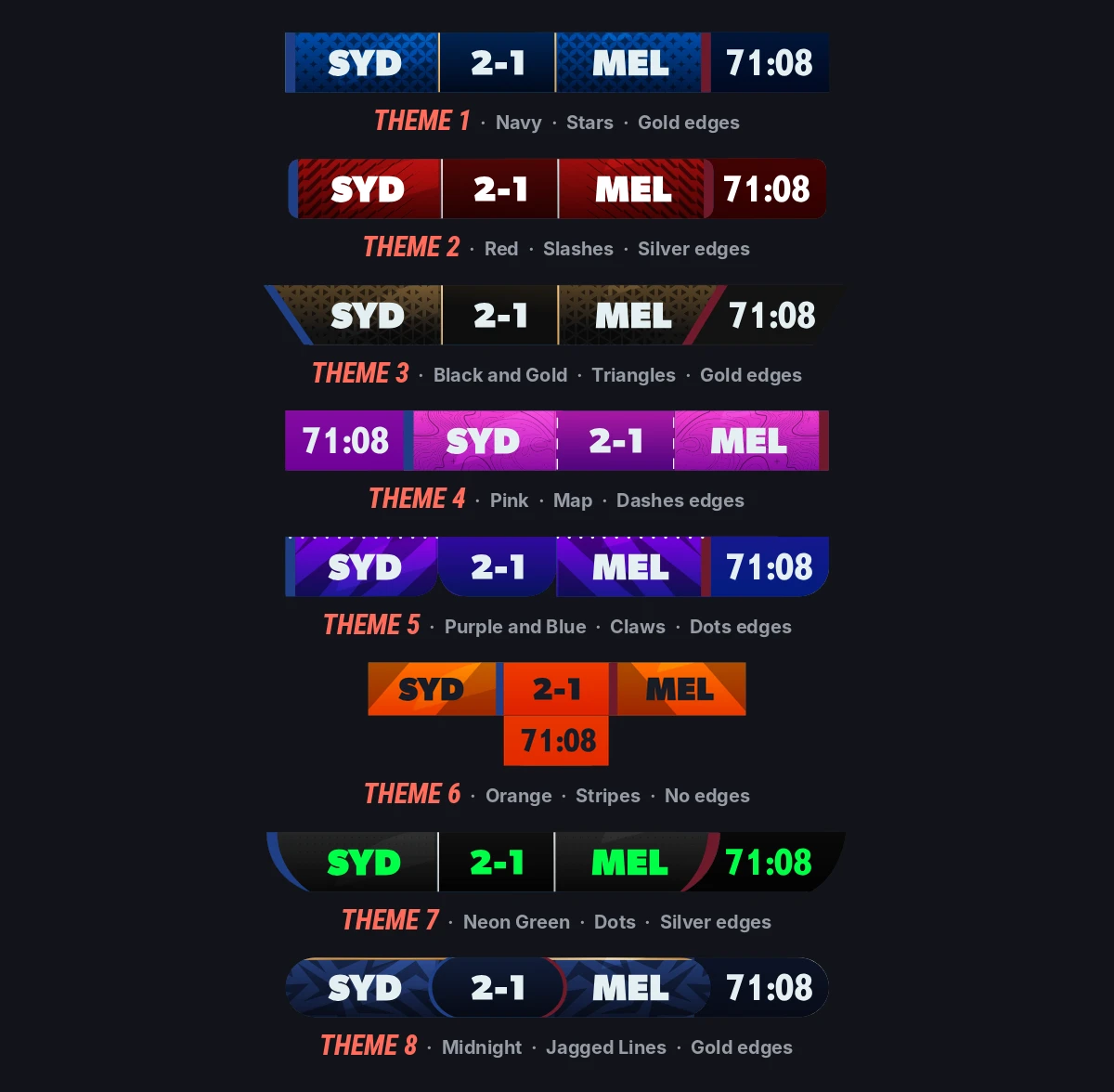
A soccer scoreboard is the least cluttered in major sport, which means every element is load-bearing.
- Team codes and the score. The home team is written first, and the score reads home to away. Zero is spoken as nil in most of the world.
- The clock. Counting up, so its value also tells you which half you are in. Anything over 45:00 is the second half.
- A plus indicator. Stoppage time, showing the minutes the fourth official signalled.
- HT and FT. Half time and full time, which are states rather than a paused clock.
- A player count badge. Shows when a team is down to ten players after a red card, which explains the shape of the rest of the match.
- AGG. The aggregate score in a two-legged tie, shown beside the score for the current leg.
We have a separate breakdown of everything a soccer scoreboard graphic has to handle, including why the count-up clock breaks most generic overlay tools.
Soccer scoring terms and abbreviations
| Term | Meaning |
|---|---|
| GF / GA / GD | Goals for, goals against, goal difference |
| Pts | League points, from three for a win and one for a tie |
| OG | Own goal |
| Pen | A goal scored from a penalty kick |
| AET | After extra time |
| Agg | Aggregate score across a two-legged tie |
| Clean sheet | Conceding no goals in a match |
| Brace | Two goals by one player |
| Hat-trick | Three goals by one player in one match |
| Nil | Zero, as in two nil |
What has changed in the soccer rules recently?
- Away goals are gone. UEFA removed the rule from 2021-22 and most other competitions have followed, so a tied aggregate now goes to extra time.
- Video review is standard at the top level. It covers goals, penalties, direct red cards and mistaken identity, and it is the reason a goal can now be taken off the scoreboard minutes after it was signalled.
- Semi-automated offside technology has been rolled out across major competitions, cutting the time a goal spends under review.
- The eight-second goalkeeper rule. From July 2025, a goalkeeper who holds the ball for more than eight seconds concedes a corner kick to the opposition, replacing the older and rarely enforced six-second indirect free kick.
Scoring a soccer match for a live stream
Soccer looks easy to score and is deceptively hard to broadcast, because the graphic has to handle a clock that freezes rather than overruns, a score that can be reversed by a review, and a player count that persists to full time. LIGR's LiveScore app covers it below feed level: an operator logs goals, cards, substitutions and corners, and the on-screen scoreboard follows, with every event timestamped so the same input produces statistics and automated highlights.
Where an official data feed exists, LIGR takes it and the graphics are identical. That is the model behind 650+ DAZN National League matches a season, and it runs down to competitions with no data provider at all, including the Corsican league. Everything on the bug is data-bound in FUSE, so a stoppage indicator or an aggregate row is a variable, not a second version of the graphic. More on LIGR for soccer.
Every function, live
The extensions above are the states this scorebug carries. Each fires from a single data change.
Frequently asked questions
How is soccer scored?
A goal is worth one point and is the only scoring action in soccer. It counts when the whole of the ball crosses the whole of the goal line between the posts and under the crossbar, without an infringement in the build-up. A match is 90 minutes plus announced stoppage time, and the team with more goals at the end wins.
How many points is a goal worth in soccer?
One. Every goal is worth exactly the same, whether it is a tap-in, a penalty kick, a free kick or a shot from 30 metres. Soccer has no multi-point scoring actions and no conversions, which is why final scores are low and a single goal is worth so much more than a single point in most other sports.
How many points do you get for a win in soccer?
Three points for a win, one for a tie and none for a loss, in almost every league in the world. Three points replaced two in order to reward teams for trying to win rather than settling for a tie. When teams finish level on points, the first tiebreaker is usually goal difference, then goals scored.
Can a soccer match end in a tie?
Yes. In league play a tie is a normal result and each team takes one point. Knockout competitions cannot end level, so a tied match goes to two 15-minute periods of extra time, both played in full, and then to a penalty shootout if it is still level.
How does a penalty shootout work in soccer?
Each team takes five kicks, alternately, by five different players. The shootout stops as soon as one team cannot be caught, so it often ends before all ten kicks are taken. If it is level after five each it goes to sudden death, one kick each until one team scores and the other misses. Shootout goals do not count in the match score.
What is an own goal in soccer?
A goal a player puts into their own net, which counts for the opposing team and is recorded as an own goal rather than credited to a scorer. A player cannot score an own goal directly from a free kick, throw-in, corner or goal kick: if the ball goes straight in from one of those, the referee awards a corner to the other team.
Why does the soccer clock count up instead of down?
Because soccer does not stop the clock for injuries, substitutions or celebrations. The referee keeps time and adds it back at the end of each half as stoppage time, announced as a minimum by the fourth official. That is why the displayed clock stops at 45:00 and 90:00 and the added minutes appear as a separate plus indicator.
Putting soccer on screen
LIGR is a cloud-native broadcast graphics platform for live sport. Score a match in the app, or take a data feed, and the scoreboard, stat panels and highlights follow automatically.