Every goal in ice hockey is worth one point, and the team with more goals at the end wins. The part that confuses people is the second scoring system sitting on top of it: the standings points a team collects across a season, where a win is worth two and a loss can still be worth one.
Hockey uses the word "points" for two entirely different things, and mixing them up is the most common source of confusion for new viewers. On the ice, a goal is one point and nothing is worth more. In the standings, a team banks two points for a win and one for a defeat that goes past regulation time. Both are explained below, kept separate, along with assists, hat tricks and every abbreviation you will meet on a scoresheet. If you want the graphics side of it, see the master scoreboard guide.
How scoring works during a hockey game
A team scores when the puck completely crosses the goal line between the posts and under the crossbar, put there legally by an attacking player. Every goal is worth exactly one point. Distance, angle, deflection, strength and dramatic value make no difference to the arithmetic. There is no three-point line in hockey and no bonus for a shot from distance.
| Event | Value | What it means |
|---|---|---|
| Goal | 1 point | Any legal goal, from anywhere, at any strength |
| Assist | 0 to the team | Up to two players credited on a goal. Player statistic only, the score does not move |
| Own goal | 1 point to the other team | Credited to the last attacking player to touch the puck, not the defender |
| Penalty shot | 1 point | A one against one attempt awarded for an illegal denial of a scoring chance |
| Empty net goal | 1 point | Scored while the opposing goaltender is off the ice for an extra skater |
| Shootout win | 1 point | One goal is added to the winner's final score no matter how many attempts were converted |
What is a point in hockey for a player?
A player point is a goal or an assist. Add them together and you have the number in the P or PTS column. A player who scores a goal and sets up two others has three points from one night. Team scoring and player scoring therefore run on different totals: a 4-3 game produces seven team goals but often fifteen or more player points once assists are counted.
How many assists are given on a goal?
A maximum of two, awarded to the last two teammates to touch the puck before the goalscorer, provided the opposition did not gain clear control in between. A goal can have two assists, one, or none at all. An unassisted goal is not an oversight, it is a real category, and it is what a scoresheet means when it prints a goal with no names after it.
Hat tricks and the other scoring milestones
- Hat trick. Three goals by one player in a single game. They do not have to be consecutive.
- Natural hat trick. Three consecutive goals by the same player, with nobody else scoring in between.
- Gordie Howe hat trick. An unofficial and much rarer version: a goal, an assist and a fight in the same game.
- Shutout. A goaltender finishing a game having conceded nothing, which appears in the SO column on a goaltending line.
How a hockey game ends, and what happens at a tie
A game is three periods of twenty minutes of playing time. The clock stops on every whistle, so an hour of hockey takes well over two hours to play. If the scores are level after sixty minutes, what happens next depends entirely on the competition.
| Situation | What happens |
|---|---|
| NHL regular season | Five minutes of sudden death overtime played three against three. If nobody scores, a shootout decides it |
| NHL playoffs | Twenty minute sudden death periods played five against five, repeated until somebody scores. There is no shootout |
| Shootout | Three attempts per team, then sudden death rounds until one team converts and the other does not |
| International and league group stages | Formats vary. Some competitions still allow a draw in group play rather than forcing a result |
The NHL removed ties from its regular season in 2005 and introduced the shootout. That is why a modern NHL standings table has no T column and an OTL column instead.
A shootout win adds one goal to the final score, not one goal per successful attempt. A 3-2 shootout result means the teams finished regulation and overtime at 2-2.
The NHL points system: how standings points work
In the NHL standings a win is worth two points, an overtime or shootout loss is worth one, and a regulation loss is worth nothing. Teams are ranked on the total, not on wins.
| Result | Standings points |
|---|---|
| Win in regulation | 2 |
| Win in overtime | 2 |
| Win in a shootout | 2 |
| Loss in overtime | 1 |
| Loss in a shootout | 1 |
| Loss in regulation | 0 |
Why do some games award three points and others two?
Because the loser keeps a point once a game passes regulation. A game settled inside sixty minutes puts two points into the standings. A game that reaches overtime puts three in, two to the winner and one to the loser. That extra point is what commentators call the loser point, and it is the reason two teams on the same number of points can have very different win records.
How are teams separated when they finish level on points?
The NHL breaks ties on the quality of the wins rather than the quantity. Regulation wins come first, then regulation plus overtime wins, the figure printed as ROW, which deliberately excludes shootout wins so a team cannot climb the table on penalty shots alone. Head to head record and goal difference follow. Where teams have played an unequal number of games, points percentage, meaning points earned divided by points available, is the fairer comparison and is widely quoted mid season.
Do other leagues use the same points system?
No. The IIHF and most European leagues use a three point system, which distributes the same total from every game: three points for a win in regulation, two for a win in overtime or a shootout, one for a loss in overtime or a shootout, and none for a regulation loss. It rewards settling the game inside sixty minutes. College and junior competitions vary again, so the rule of thumb is to read the competition regulations rather than assume the NHL model.
Hockey scoring abbreviations, decoded
| Abbreviation | Meaning |
|---|---|
| G | Goals |
| A | Assists |
| P or PTS | Points, goals plus assists |
| +/- | Plus minus. Plus one for being on the ice for an even strength or short handed goal for, minus one for one against. Power play goals do not count towards it |
| PIM | Penalties in minutes |
| PPG | Power play goal, scored while the other team is short a player |
| SHG | Short handed goal, scored while your own team is a player down |
| ENG | Empty net goal |
| GWG | Game winning goal, the one that put the winners ahead for good |
| S or SOG | Shots on goal, which excludes blocked and missed shots |
| TOI | Time on ice |
| SV% | Save percentage, saves divided by shots faced |
| GAA | Goals against average, goals conceded per sixty minutes played |
| GP, W, L, OTL | Games played, wins, regulation losses, overtime or shootout losses |
| ROW | Regulation plus overtime wins, a standings tiebreaker |
| SO | Shutouts on a goaltender line, shootout in a standings table. Same letters, different column |
How to read a hockey scoreboard during play
The graphic on screen carries more live state than almost any other sport. Alongside the score and the period clock counting down from 20:00, it shows the strength state, written as 5v5, 5v4 or 5v3, a countdown for every penalty being served, and usually shots on goal. Strength is the most useful thing on there for a new viewer: 5v4 means one team is a player short and is far more likely to concede. A minor penalty ends early if the team on the power play scores, which is why the numbers can change without a whistle. The full breakdown is in our guide to what an ice hockey scoreboard has to show.
Where this fits at LIGR
LIGR builds the broadcast graphics that carry all of this live. Below the top professional tier there is no commercial hockey data feed, so the LiveScore app becomes the feed: an operator taps goals, assists, penalties and shots as they happen, every event is timestamped, and the scoreboard, the strength chip and the penalty clocks update themselves. The graphic is designed in Rive and bound to live data in FUSE, so it runs in a browser with no hardware at the rink. See every sport LIGR supports.
Every function, live
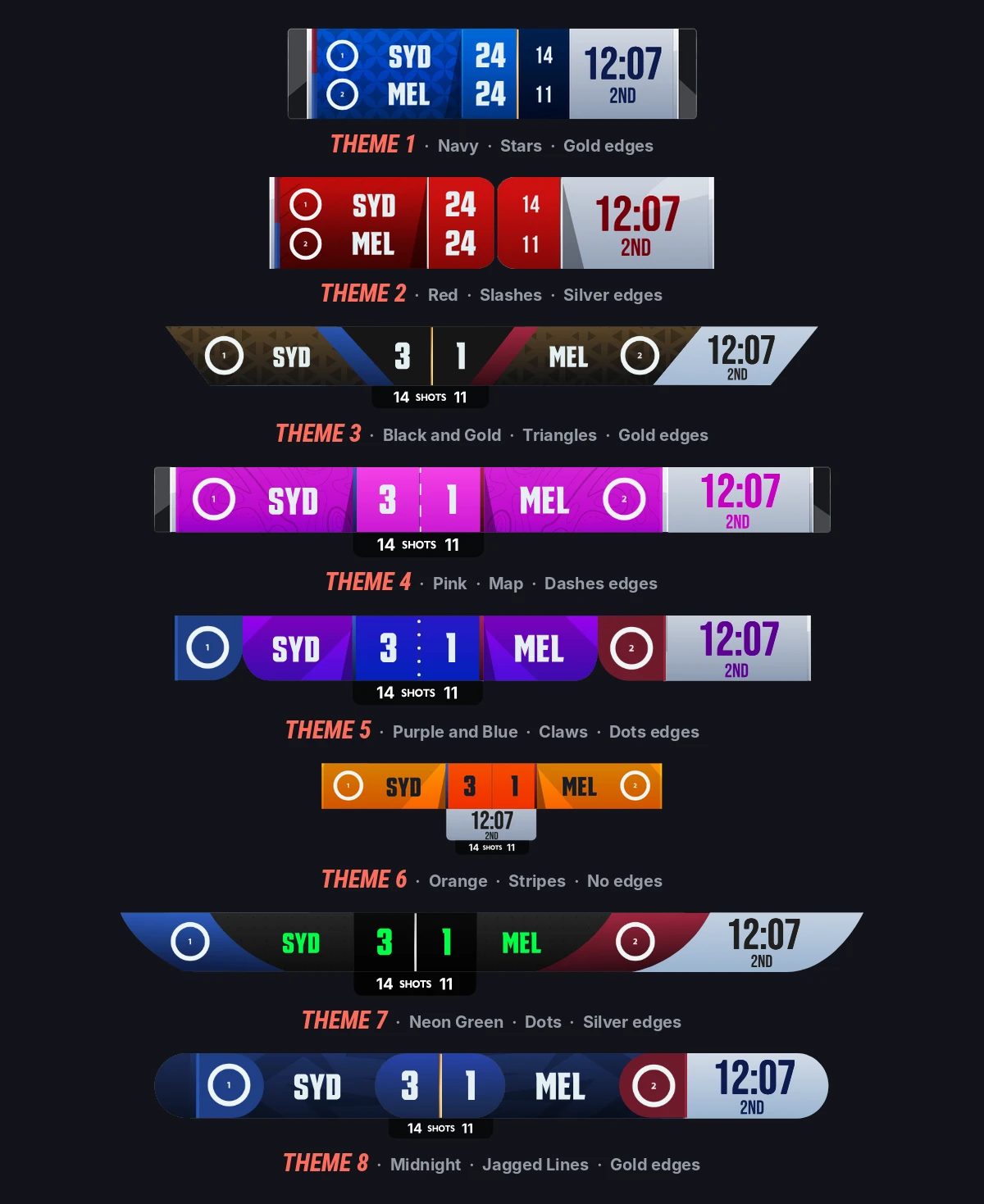
The extensions above are the states this scorebug carries. Each fires from a single data change.
Frequently asked questions
How many points is a goal in hockey?
One. Every goal in ice hockey is worth a single point on the scoreboard, whatever the distance, angle or situation. There is no long range bonus and no equivalent of a three point shot. The word points causes confusion because it is also used for two other things: a player's goals plus assists, and the standings points a team earns from a result.
How does the NHL points system work?
A team gets two points for a win, whether it comes in regulation, overtime or a shootout. A team that loses in overtime or a shootout still gets one point. A team that loses in regulation gets none. That means a game decided inside sixty minutes puts two points into the standings, while a game that goes to overtime puts in three.
What is an overtime loss worth in the NHL standings?
One point. It appears in the OTL column and counts towards the team's total, which is why NHL standings are sorted on points rather than wins. Commentators call it the loser point. A shootout loss is worth the same one point, and both are recorded separately from a regulation loss, which is worth nothing.
How many assists can be awarded on one goal?
A maximum of two. They go to the last two teammates who touched the puck before the goalscorer, as long as the opposition did not take clear control in between. A goal can carry two assists, one or none. Assists are player statistics only: they add to a player's point total but never change the team score.
What is a hat trick in hockey?
Three goals scored by the same player in one game. They do not have to be consecutive. Three in a row with nobody else scoring in between is a natural hat trick. A Gordie Howe hat trick is an unofficial and much rarer feat: a goal, an assist and a fight in the same game.
What happens if a hockey game is tied?
In the NHL regular season the teams play five minutes of sudden death overtime three against three, and if nobody scores it goes to a shootout. In the playoffs there is no shootout: teams play full twenty minute sudden death periods until someone scores. Other competitions vary, and some still allow a draw in group stage matches.
What does ROW mean in the NHL standings?
Regulation plus overtime wins. It counts every win except those decided by a shootout, and it is used to separate teams that finish level on points. The reasoning is that a shootout is a skills competition rather than hockey, so a team should not be ranked ahead of another on the strength of shootout results alone.
What do G, A and P mean on a hockey scoresheet?
Goals, assists and points. Points is simply goals plus assists, so a player with two goals and one assist has three points. Nearby columns usually include PIM for penalty minutes, plus minus for goals scored and conceded while that player was on the ice at even strength, and SOG for shots on goal.
Putting hockey scoring on screen
Cloud native broadcast graphics for ice hockey: period clock, strength state, stacked penalty clocks and every goal chip, driven by real match events rather than typed in by hand.