A hockey scoreboard graphic must show the score, a period clock counting down from 20:00 that stops on every whistle, the period, and the on-ice strength state: 5v5, 5v4, 5v3, 4v4 or 6v5 with the goalie pulled. In a live broadcast the same graphic is also called the scorebug. Strength is what makes ice hockey different. Every penalty clock and every goal chip hangs off it, and a bug that cannot express it is not a hockey bug.
What a hockey scoreboard must show
Hockey packs more simultaneous live state into the bug than almost any other sport. These are the persistent elements and their sources.
| Element | Why it matters | Source of data |
|---|---|---|
| Score (home : away) | Low-scoring sport, so every digit change is worth animating | Scoring app or official feed |
| Period clock | Counts down from 20:00, stops on every whistle. Must freeze on the stoppage, not drift through it | Official timekeeper, mirrored in the scoring app |
| Period pill | 1st, 2nd, 3rd, OT, SO. Determines clock length and which rules apply | Match state |
| Strength chip | 5v5, 5v4, 5v3, 4v4, 6v5. The most useful thing on the bug for a casual viewer | Derived from active penalties plus goalie-pulled state |
| Penalty clocks | One tile per active penalty: jersey number, length, time remaining, stacked per team | Penalty events plus the period clock |
| Power play clock | Time left on the man advantage, not always any one penalty clock | Derived from active penalties against the other team |
| Empty net chip | A pulled goalie changes the strength state and the stakes of every shot | Goalie-pulled event |
| Shots on goal | The standard persistent stat pair, per period and per match | Shot events, excluding blocked and missed shots |
| Team identity | Crest, abbreviation and colour, always visible | Competition and team records |
| Shootout rail | Replaces the clock once a tie goes to a shootout | Shootout attempts |
Strength state is the hard part
Strength is a derived value, not a field somebody types in. It is the number of skaters each team has on the ice right now, and it is the product of two independent things: which penalties are running, and whether a goaltender has been pulled for an extra attacker. That is why a fixed-layout hockey bug falls over. These states are not edge cases, they happen most nights:
- 5v4 from a single minor.
- 5v3 when a second penalty overlaps the first, the highest-value situation in hockey.
- 4v4 from coincidental minors, where neither team is on a power play and no penalty-kill tag should show.
- 3v3 in NHL regular-season overtime.
- 6v5 or 6v4 when the trailing team pulls its goalie late.
- 4v5 and the rest, because the chip has to read correctly from both sides.
Two rules govern the clocks, and getting them wrong is the most common error in amateur hockey graphics:
- A minor ends on a power-play goal against. A major does not. When the team on the power play scores, the earliest running minor is killed and that player returns immediately. A five-minute major runs its full length no matter how many goals go in.
- A double minor is two 2:00 clocks, not one 4:00 clock. The second half only starts when the first expires or is killed by a goal, and each half ends independently on a goal against. Rendering it as a single four-minute countdown will show the wrong time the moment a goal goes in.
Then the misconduct, which breaks naive logic entirely: ten minutes puts a player in the box but the team does not play short, so it needs a penalty tile that leaves the strength chip alone. Same for a game misconduct, unless it rides alongside a major.
Test for any hockey scoreboard: call coincidental minors, pull the trailing team's goalie, then score a power-play goal. If the chip does not walk 5v5 to 4v4 to 5v4 to 5v5 correctly, and the killed minor does not vanish the instant the puck crosses the line, the logic is wrong.
Clock craft matters too. The period clock stops on every whistle, so the bug must freeze cleanly rather than catch up in a jump, and penalty countdowns pause with it because they are measured in playing time. Digits should be tabular, so the clock does not shuffle sideways as 10:00 becomes 9:59.
Scoring events and what the bug does
In hockey a goal is not just a score change. It carries a strength annotation that changes how it is recorded.
| Strength | What it means | Effect on the bug |
|---|---|---|
| ES | Even strength | Standard goal treatment, no chip emphasis |
| PP | Power-play goal | PP chip, and the earliest minor against the conceding team is killed |
| SH | Short-handed goal | SH chip. It does not end the penalty; the other team stays on the power play |
| EN | Empty net | EN chip. The conceding side had its goalie pulled, so it is not charged against a goaltender's save percentage |
| PS | Penalty shot | Its own strength on the goal record |
The subtle requirement: the chip must show the strength at the moment of the goal, not the strength now. A goal scored at 5v4 that ends the penalty is still a power-play goal, even though the teams are back at 5v5 by the time the graphic renders. A bug reading current strength labels it ES and the stat record is wrong.
Beyond the goal itself: up to two assists, suppressed cleanly when there are none; penalty shots and their outcome; a hat-trick alert on a third goal; icing and off-side as brief chips that do not disturb the score; and video review, which holds a pending goal digit until the review resolves and rolls it back if the goal is overturned.
Penalties, ejections and player counts
| Penalty | Length | Does the team play short? | Ends early on a goal? |
|---|---|---|---|
| Minor | 2 minutes | Yes | Yes, on the first goal against |
| Double minor | 2 + 2 minutes | Yes | Each half independently |
| Major | 5 minutes | Yes | No, it runs in full |
| Misconduct | 10 minutes | No | n/a |
| Game misconduct | Rest of match | No, unless paired with a major | n/a |
| Match penalty | 5 minutes plus ejection | Yes, usually served by a substitute | No |
| Coincidental majors | 5 minutes each | No, even strength is maintained | No |
Two more states belong on the bug. The delayed penalty: the referee's arm is up, play continues until the offending team touches the puck, and the side about to go on the power play often pulls its goalie meanwhile. A corner chip that clears on the whistle or a goal. And the penalty-kill tag, which must never show on both teams at once, because two teams a skater down is 4v4, not a mutual kill.
Extensions worth putting on a hockey scoreboard
A scorebug extension is a stat panel that pops out of the bug on a milestone or an operator cue, then retracts. The hockey ones worth having:
- Shots on goal. The default persistent stat, per period and per match. Exclude blocked and missed shots rather than quietly folding them in.
- Goaltender save percentage. Saves over saves plus goals against, excluding empty-net goals so the number stays honest.
- Power-play and penalty-kill efficiency. Conversion rate per team, which is the argument most hockey broadcasts are actually having.
- Ice-time leaders. Time on ice and shifts, but only where shift data exists. If it does not, hide the panel rather than render zeros.
How LIGR drives a hockey scoreboard
Below the top professional tier, ice hockey generally has no commercial data feed. That is the central problem in buying hockey scoreboard software, and the one LIGR is built around.
Where an official feed exists, LIGR takes it. Where it does not, the LiveScore app is the feed. An operator taps real events as they happen, a goal with its assists, a minor, a goalie pulled, a shot on goal, and each is written with a timestamp. Because that record exists, the strength chip can be derived rather than typed, the stat panels have something to read, and automated highlights come off the same taps.
The scoreline is designed in Rive and bound to live data in FUSE, LIGR's graphics configuration engine. That binding is why strength works: the chip is a variable driven by match state, not hand-drawn images somebody swaps, so 5v3 or 6v4 is a value the graphic already understands rather than a redraw. Penalty tiles are the same, a repeating data-bound element rather than a fixed pair of boxes.
Game Plans decides when things appear: penalty tiles mount on the penalty event and clear when the countdown ends, goal graphics fire off the goal, break playlists run to the clock. Want a human in the loop, and the Control Room gives an operator manual control from the browser. If not, auto mode runs the match from the data alone. Same stack as 650+ DAZN National League matches a season, and it works the same way across every sport we support.
Every function, live
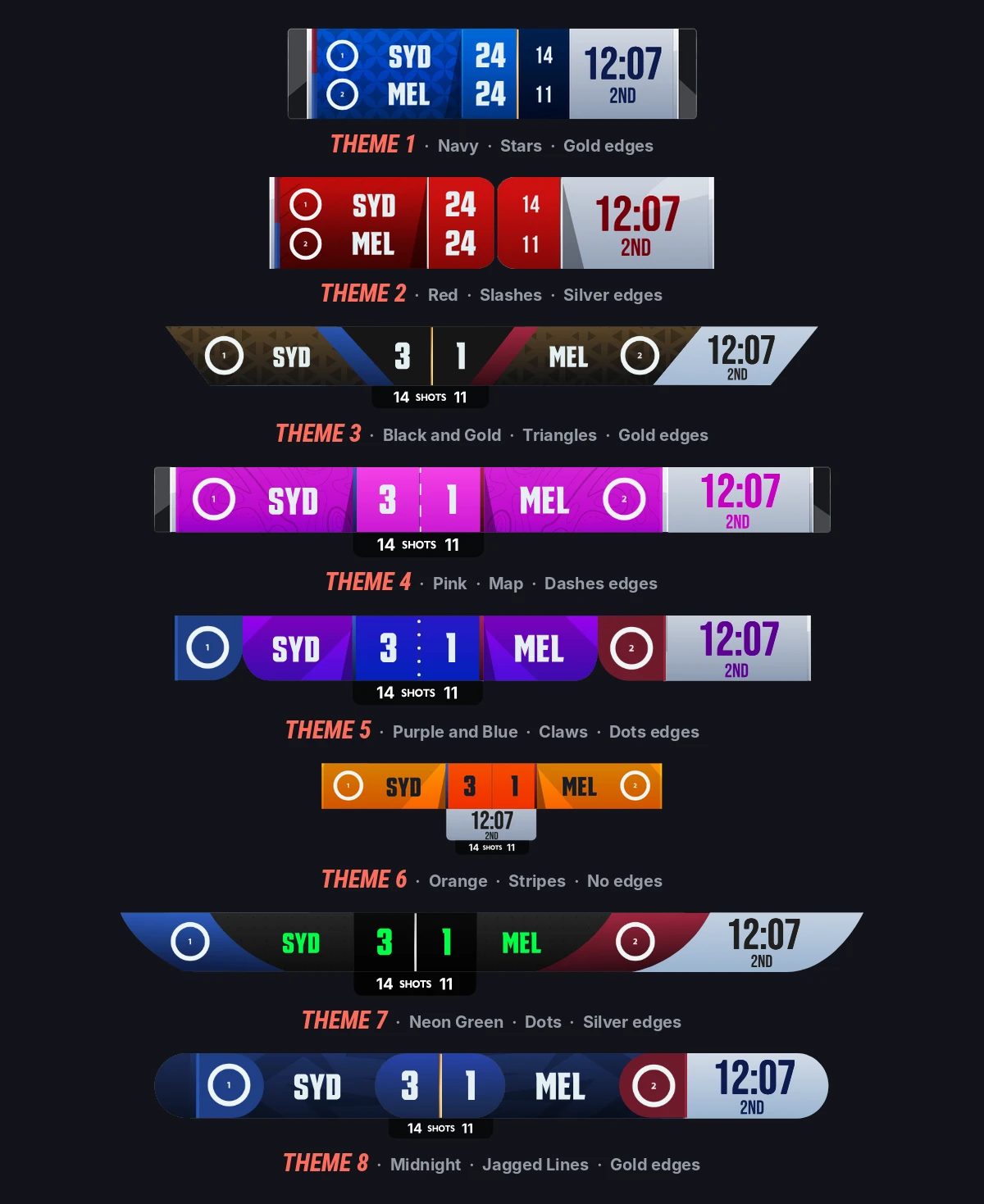
The extensions above are the states this scorebug carries. Each fires from a single data change.
Frequently asked questions
What is a hockey scoreboard overlay?
A hockey scoreboard overlay is the graphic laid over a live stream or broadcast to carry the match state, and in production it is also called the scorebug. An ice hockey scoreboard overlay has to show the score, the period, a period clock that freezes on every whistle, the strength state such as 5v4, and a countdown for each active penalty. Shots on goal and an empty-net chip are the usual additions.
What does an ice hockey scorebug need to display?
Team identities, the score, a period clock counting down from 20:00 that freezes on every whistle, and the period. Hockey then adds three things most sports do not need: the on-ice strength state such as 5v4 or 5v3, a live countdown for each active penalty stacked per team, and an empty-net indicator when a goalie is pulled. Shots on goal is the standard extra.
What is a strength state on a hockey scorebug?
Strength is the number of skaters each team has on the ice, shown as a chip like 5v5, 5v4, 5v3, 4v4 or 6v5. It is derived from two inputs: which penalties are currently running, and whether a goaltender has been pulled for an extra attacker. It should never be entered by hand, because it changes the instant a penalty expires or is killed by a goal.
How many penalty clocks can be running at once?
Up to three per team can be active, with further penalties queued behind them, so a hockey bug needs stacking tiles rather than one penalty slot. Each tile carries the jersey number, the penalty length and the time remaining. When one expires the next in the queue starts, and the strength chip recalculates from whatever is left running.
Does a penalty end when the other team scores?
A minor penalty does. When the team on the power play scores, the earliest running minor is killed and that player returns immediately. A five-minute major does not end early, it runs in full regardless of how many goals are conceded. A double minor is two separate two-minute halves, and each half ends independently on a goal against.
What do ES, PP, SH and EN mean on a goal graphic?
They are the strength annotations for how the goal was scored: even strength, power play, short-handed and empty net. They change how the goal is recorded, not just how it is described. An empty-net goal is not charged against a goaltender's save percentage, and a short-handed goal does not end the opposition's power play the way a power-play goal ends a minor.
Can you run hockey graphics without a data feed?
Yes. Most hockey outside the top professional leagues has no commercial data feed, so LIGR uses its LiveScore app instead, a hockey scoreboard app run from a phone or tablet. An operator taps goals, assists, penalties, shots and the goalie being pulled as they happen, and every event is timestamped. The scorebug renders identically whether the events arrived from an official feed or the app.
Put a proper hockey scoreboard on your coverage
Cloud-native broadcast graphics: your hockey scoreboard runs online in the browser, with no hardware and no per-match operator. Start free, or tell us what your competition needs on screen.
Related reading
- How scoreboard graphics work across every sport
- Every sport LIGR supports
- FUSE, binding designs to live match data
- Game Plans, triggering graphics from match events
- DAZN National League, 650+ matches a season