Cloud Streaming · Monitoring
Find the dead feed before the client does
Running one match well is a craft. Running forty at once is a monitoring problem, and it is won or lost by whether a person can see, at a glance, which of the forty is broken. That is what the wall and the indicators are for.
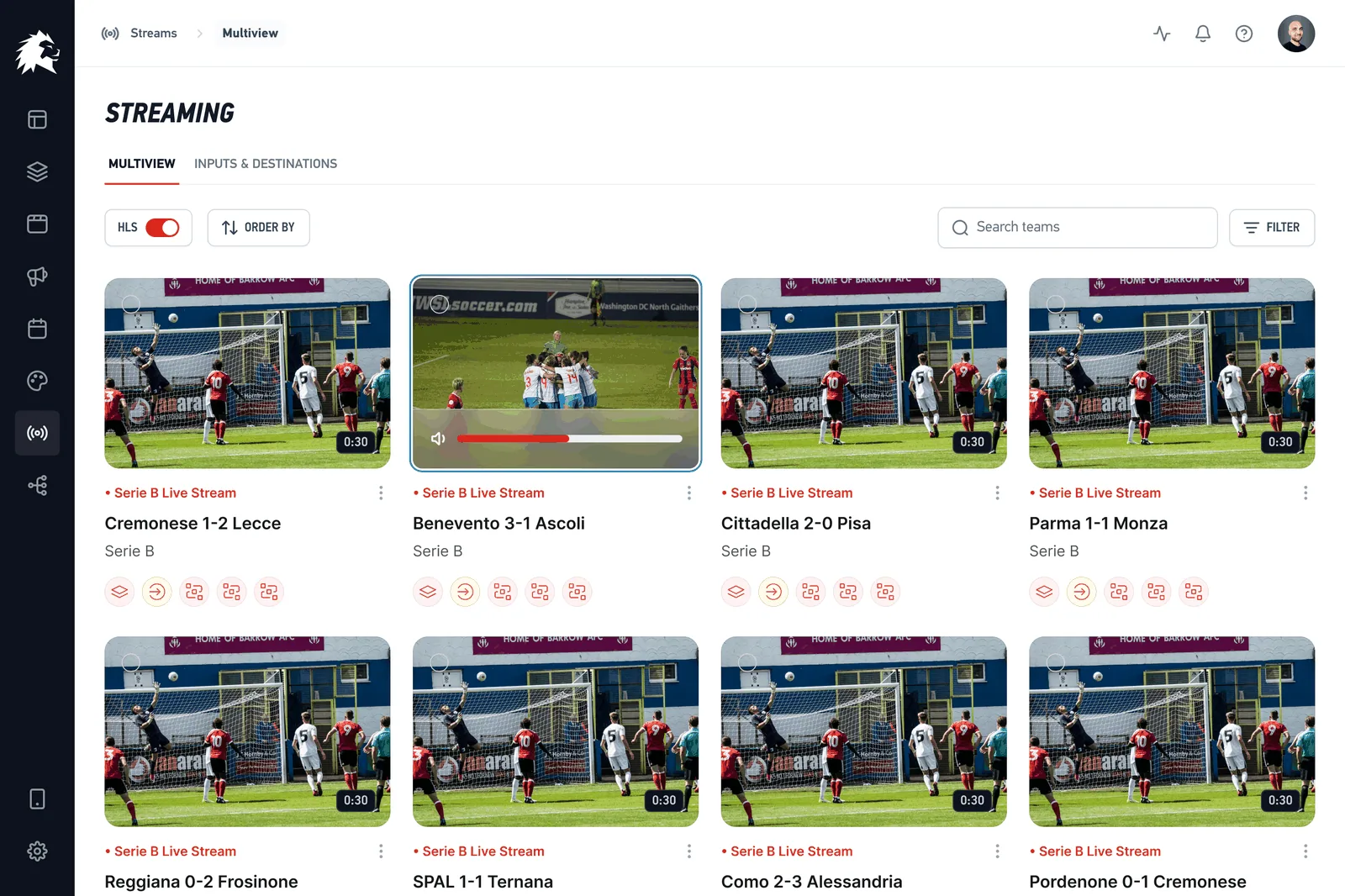
Multiview
Every active stream, one page
What a tile shows
A live preview, the fixture, the stream name, a volume slider, a toggle to view the input feed without graphics, and status indicators for the stream, the overlay, the input and the destinations.
Narrowing it down
Filter by sport, competition, club, team or match, and order the wall by match or competition. With dozens of fixtures running, the filter is the feature.
Clicking a tile opens that stream full screen with the full set of controls. The volume sliders on the wall affect only what the person monitoring hears, never the broadcast audio, which is the sort of detail that stops someone ruining a match while checking it.
The colour system
Four colours, one meaning each
Grey
Configured but idle. A stream not started, an input receiving nothing, a destination not sending. Grey is not an error, it is a thing waiting.
Yellow
Starting up. Appears on streams only, during initialisation, and normally clears in two to three minutes.
Red
Live. Counterintuitive if you expect red to mean fault, but here red is the colour of a thing that is working: a stream on air, an input receiving, a destination connected.
Warning icon
Something is missing or has failed. A stream with no input assigned cannot start. A destination that failed to connect retries roughly every twenty seconds.
The same system runs across streams, overlays, inputs and destinations, in the matches table, the expanded match view, the monitoring page and the wall. A number on an icon is a count: three on the destination indicator means three destinations on that match.
One stream, up close
The page you open when one goes wrong
The monitoring page carries the player, the match information, and both ends of the pipeline side by side: input details and bitrate on the left, destinations and their bitrates on the right. A warning icon on the input means nothing is arriving; a green reading with a rate means it is.
Overlay controls sit under the player: reassign the overlay, refresh its production URL, or hide the graphics entirely to check the clean feed. Audio sits there too, so mixing or muting a channel mid-match does not require going anywhere else.
The three-dot menu reaches stream settings, the Stream Session Analyzer with its input stability graph, and the LiveScore App. Between them that is diagnosis and cause: the analyser tells you whether the feed from the venue was stable, which is usually the argument you are trying to settle.
Known shapes
What it usually turns out to be
Stuck on yellow
Two to three minutes is normal initialisation. Past roughly ten minutes it is stuck: create a new stream for the match and start that. Rare, and this resolves nearly all of it.
Red at the destination, nothing on the platform
Red means LIGR connected successfully and is sending. The problem is at the far end: stream key, event state, or visibility settings on the platform.
Still being charged
The stream was never stopped. Closing the tab does not stop it. Check the wall, stop it there, and use Auto Stream's stop time so it cannot happen again.
Common questions
Answered, from the product
What does red mean?
Live and working. A red stream is on air, a red input is receiving video, a red destination is connected and sending. Errors show as a warning icon, not as red.
How long should a stream take to start?
Two to three minutes is normal. Beyond roughly ten minutes it is stuck, and the fix is to create a new stream for the match.
Can I stop one destination without stopping the broadcast?
Yes. Destinations are controlled separately: select the one to stop and stop it, and the others keep going.
Does the volume slider on the wall change the broadcast?
No. It only affects what you hear while monitoring.
Where do I see whether the venue feed was stable?
The Stream Session Analyzer, reached from the three-dot menu on the monitoring page. It shows an input feed stability graph alongside other performance detail.
Can I monitor from Match Center instead?
No. Match Center covers match events and highlights during a live match. Bitrate, input status, destination status and overlay controls are on the monitoring page.
Go deeper
More on cloud streaming
Inputs and destinations
The configuration behind everything this page is watching.
See the setupMulti-stream orchestration
One match, many feeds, and what it takes to run a lot of them at once.
See orchestrationProduction companies
The operating model this enables: fifty concurrent matches, one control room.
See the solutionReady to elevate your sports broadcast?
Join hundreds of organisations using LIGR to deliver broadcast-quality production — from local leagues to national federations.