Cloud Streaming · Inputs and destinations
Whatever the venue sends, wherever it needs to go
A stream has two ends and both of them belong to somebody else. The camera at the ground was chosen by whoever runs the ground. The platform at the other end was chosen by whoever owns the rights. Inputs and destinations are how you stop either of those being your problem.
Coming in
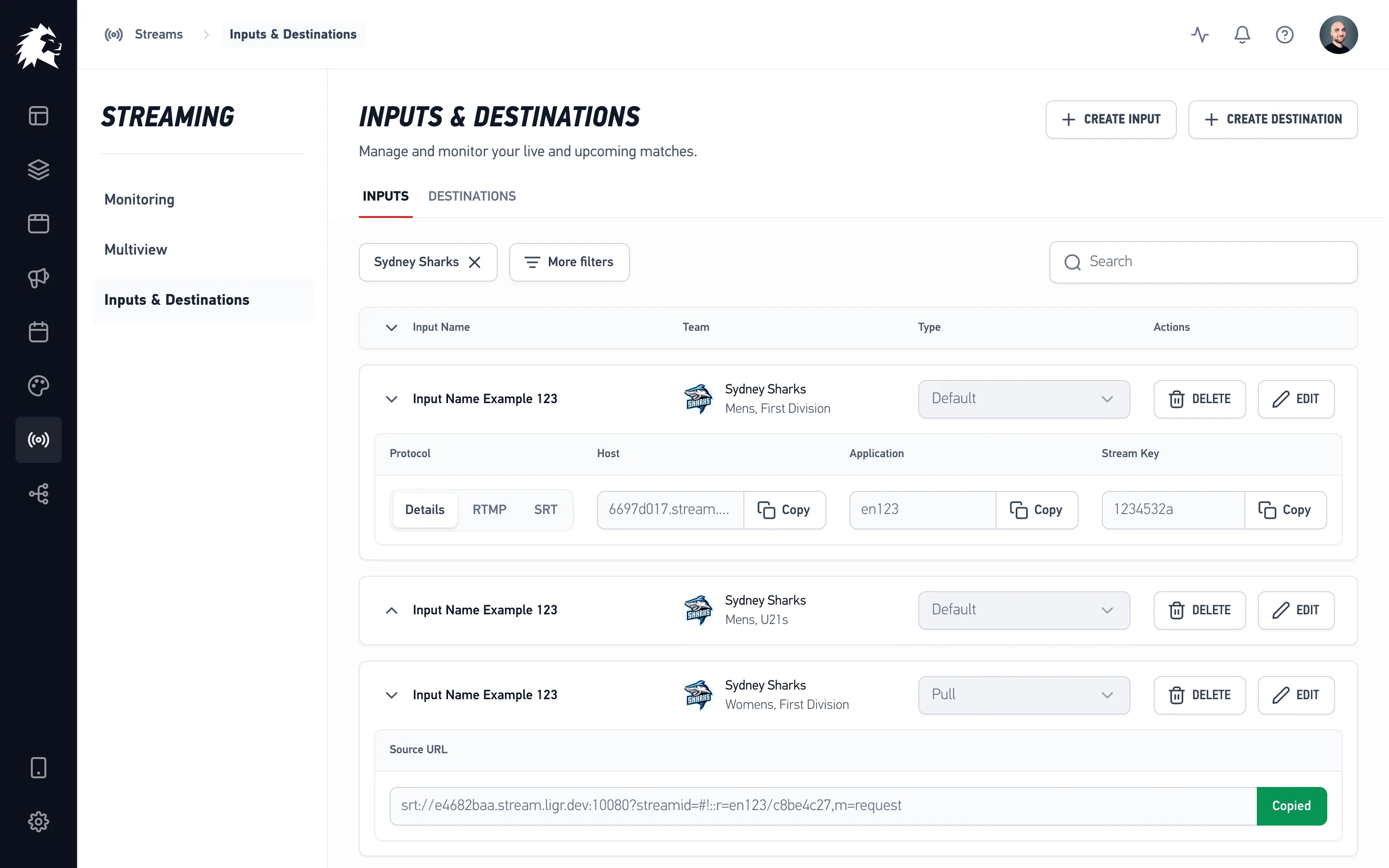
One input, two protocols
RTMP
You get a URL and a stream key. Paste both into the encoder, the camera system or the software at the venue. The most widely supported option and the one most kit defaults to.
SRT
A single link instead of a pair. Preferred where the path between the venue and the cloud is unreliable enough that packet loss matters.
An input is created once, given a name a human recognises such as Main Camera or Field Camera, and then assigned to a stream. One input per stream, and a stream cannot start without one.
That naming matters more than it sounds when somebody is assigning a feed to a fixture on a Saturday morning and the list is long.
Going out
Up to three, changed mid-match
A destination is wherever the finished feed is published: YouTube, Facebook, a custom RTMP endpoint, an SRT endpoint, a partner's ingest. It is created once with its connection details and then attached to a stream, up to three at a time.
The useful part is that destinations are controlled separately from the stream. You can add one or remove one while the match is running, and the broadcast does not stop. You can stop one destination and leave the others going. A destination that is already attached to another stream has to be released from that one first, which is a guard rail rather than a limitation.
Each destination also takes a feed type. Program carries the graphics and is what an audience should see. Clean carries the video alone, for a production partner or a recording system that adds its own. Graphics missing at one destination and present at another is almost always this setting.
The stream itself
Configured once, reused all season
A template does the filling in
Stream templates are built at competition level and populate every setting below them. For a league running the same configuration across hundreds of fixtures, this is the difference between a checklist and a click.
Output settings
Resolution at 1080p or 720p, frame rate, video bitrate and a server region chosen for proximity to the venue. Set at creation, changed only when the stream is stopped.
Audio before it matters
Input volume, mixing the left and right channels together, or muting one of them. Adjustable while live, which is the point: audio problems are discovered during a match, not before one.
An idle image
What the destination shows before kickoff and after the whistle, instead of black.
Graphics off the top
Start Overlay as Hidden keeps the package out of shot until an operator calls it, for productions that want a clean open.
Recording and clipping
Generate Highlights has to be on for clips to be cut from match events, and turning it on stores the full match recording automatically.
Some settings can be changed while the stream is live and some cannot. Destinations, the overlay assignment and audio are all live-changeable. Frame rate, resolution, region and the input assignment are not: those need the stream stopped, changed and restarted.
Auto Stream
Three timings, then nobody starts anything
01
Stream Start
The stream comes up a set number of minutes before the scheduled kickoff, so the pipeline is warm rather than being built while people are waiting.
02
Go Live
Destinations begin receiving a set number of minutes before kickoff, which is when the audience can actually see something.
03
Stream Stop
The stream stops a set number of minutes after the match ends. This is the one that protects the bill.
The documented standard configuration is ten minutes before, five minutes before, ten minutes after. A tighter one is five, two and five. Both are timed from the scheduled kickoff set when the match was created, which matters: if the match actually starts late, the automation does not wait for it.
Charging begins when the stream starts and continues until it stops. Closing the browser does not stop either, which is the single most expensive misunderstanding available here.
Common questions
Answered, from the product
What can send a feed to LIGR?
Anything that outputs RTMP or SRT: AI camera systems, hardware encoders, and software encoders like OBS and vMix. RTMP uses a URL and a stream key, SRT uses a single link.
How many destinations can one stream have?
Up to three, selected from the destinations you have created. They can be added and removed while the stream is live.
Why are graphics missing at one destination?
That destination is almost certainly set to Clean rather than Program. Clean carries the video with no graphics, for partners who add their own.
Can settings be changed during a match?
Destinations, the overlay assignment and audio, yes. Frame rate, resolution, region and the input assignment, no: those need the stream stopped first.
Why will a stream not start?
Most often no input is assigned, which shows as a warning on the input indicator. A stream also needs at least one configured destination and available stream hours.
Does closing the tab stop the stream?
No, and it does not stop charging either. A stream runs until it is stopped manually or by the Auto Stream stop time.
Go deeper
More on cloud streaming
Stream monitoring
Once it is running: the wall, the bitrate monitors and what each status colour means.
See monitoringMulti-stream orchestration
One match, many feeds, and the operating model behind running a lot of them at once.
See orchestrationCloud Streaming
The module this sits under: cloud ingest, composition and delivery.
See the moduleReady to elevate your sports broadcast?
Join hundreds of organisations using LIGR to deliver broadcast-quality production — from local leagues to national federations.