Highlights · Moments Editor
Clip the moments nobody logged
Automatic highlights are only ever as complete as the match data behind them. A goal gets entered, so a goal gets clipped. The save that kept the score at nil, the near miss off the bar, the celebration in the crowd: nobody logged them, so nothing cut them. The Moments Editor is where you go and get them yourself, out of the full match recording, without leaving the platform.
The gap
Match data is good. It is not everything
Every automatic highlight starts as an event someone entered while the match was running. That is what makes the library fill up during the broadcast rather than after it, and it is also the limit: the clip list can only ever be as good as the event list.
The full recording has everything the event list does not. The Moments Editor opens that recording on a timeline, lets you find the bit you actually want, and cuts it into the same library the automatic highlights land in. Nothing is exported, downloaded, re-uploaded or rebuilt.
Finding it
Eighty minutes, navigable
A timeline grouped by half
First Half, Half Time, Second Half and Full Time are laid out as their own bands, so an eighty-minute recording is navigable rather than a single grey bar. Zoom in when you need the detail.
Scan at speed, then slow down
Run the recording at 2x or 4x to get through a match quickly, then drop back to normal speed once you are on the passage you want.
Filter to the event you are hunting
Every event the match produced sits above the timeline as its own filter, with a count. Pick one and the timeline shows you where those happened, so finding the third corner is a click rather than a scrub.
Half filters on the moment list
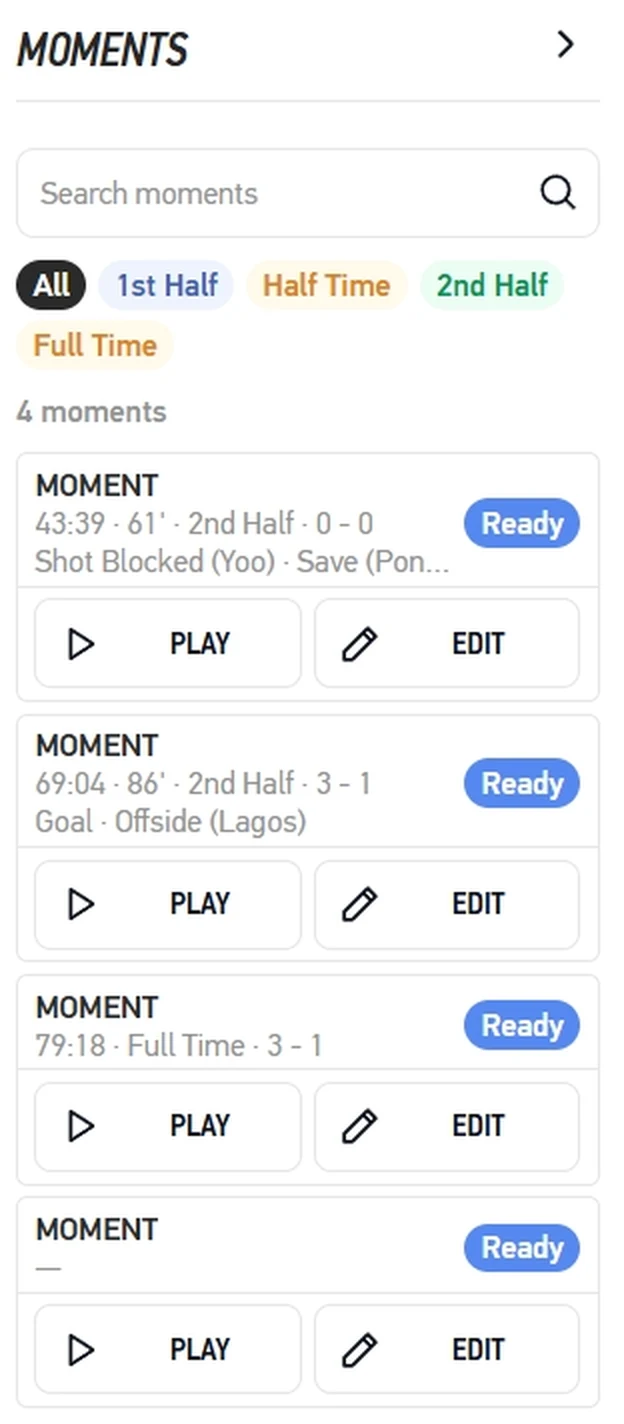
Once you have a few, the list filters by half as well, and the search bar covers their names. Each one shows its start time, its duration and which half it came from.

Cutting it
Four fields, then it exists
01
Pause on the passage
The New Moment button only appears once playback is paused. That is deliberate: a moment is cut against a specific frame, not against a video that is still running.
02
Name it
Give it a title while you are looking at it. A library of moments called Moment 1 through Moment 40 in March is a library nobody searches in September.
03
Set lead and lag
Lead is the seconds of recording before the moment, lag is the seconds after. Both default to fifteen. The duration updates as you move them, so you are choosing a clip length rather than guessing at one.
04
Tag it, if it earns one
Optional, and worth doing now rather than later. A tag applied while you can still remember why the moment mattered is the one that makes the end-of-season compilation easy.
Where it lands
The same library as everything else
Save, and the moment appears in the moments list and reflects straight into Multimedia > Highlights. From there it behaves like any other highlight: edit it, share it, download it, pull it into the video editor, combine it with others.
That is the whole point of cutting it here rather than in something else. It is not a file you now have to look after. It is a highlight, in the same library, with the same tags and the same permissions as the ones the platform cut on its own.
Afterwards
Cut rough, tighten later
Nothing is final. Open Edit on any moment to rename it, tag it, move the lead and lag, or download it directly, and the changes reflect back into the Highlights library rather than forking into a second version.
In practice that changes the working habit. You cut roughly while you are watching, and you tighten the ones that turn out to matter, instead of trying to get every clip right first time.
Working practice
What the good ones do differently
Build the tags before the season, not during it
Goal of the Week, Save of the Week, Play of the Week, Goal of the Season, Championship Highlights. Having them ready is what lets you tag during a break in play instead of promising yourself you will do it later.
Name things the same way every time
Competition, team, date, event type. The search covers names and descriptions, which only helps if there is a convention behind them.
Cut the moments, then archive the recording
Match recordings are large. Once the moments you want are out of a recording, the recording itself does not need to sit in the active library.
See it move
The walkthrough, end to end
Common questions
Moments, answered
How is a moment different from a highlight?
A highlight is cut automatically from an event entered during the match. A moment is one you capture yourself, either live by hitting Add Moment during the stream, or afterwards from the recording. Once saved they live in the same library and behave identically.
Do I need the match to be over?
No. Moments can be added live during a stream, and cut from the recording afterwards. The editor works on whatever recording exists.
What are lead and lag?
Lead is how many seconds of recording are included before the moment, lag is how many after. Both default to fifteen seconds and can be changed when you create the moment or at any point afterwards via Edit.
Can I change a moment after saving it?
Yes. Rename, re-tag, adjust the lead and lag, or download it, and the change reflects into the Highlights library.
What should I be cutting as moments?
Anything that did not trigger an automatic highlight: near misses, saves that were never logged as events, crowd reactions, celebrations, and anything that works on social without being tied to an official match event.
Where do moments end up?
In the moments list on the recording, and in Multimedia > Highlights alongside every automatic clip, where they can be tagged, shared, downloaded, edited or combined.
Go deeper
More on highlights
Video Editor
Once the moments exist, the browser timeline that assembles them into a package with your own graphics.
Open the editorHighlights
The module this sits under: automatic clipping, full match recording and the library it all lands in.
See highlightsGame Plans
The same match events that drive automatic clipping also drive what goes to air during the broadcast.
See Game PlansReady to elevate your sports broadcast?
Join hundreds of organisations using LIGR to deliver broadcast-quality production — from local leagues to national federations.